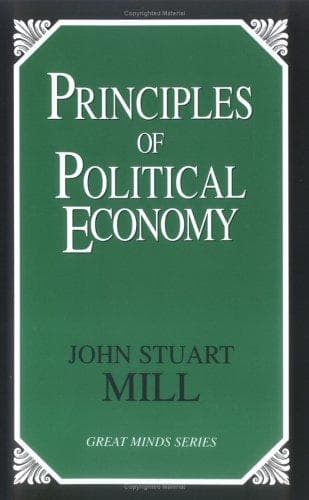
Principles of Political Economy: Abridged with Critical, Bibliographical, and Explanatory Notes, and a Sketch of the History of Political Economy — John Shaqi
Principles of Political Economy: Abridged with Critical, Bibliographical, and Explanatory Notes, and a Sketch of the History of Political EconomyMill, John Stuart
PhilosophyPhilosophy
Principles of Political Economy: Abridged with Critical, Bibliographical, and Explanatory Notes, and a Sketch of the History of Political Economy
Mill, John Stuart
Economics
Principles Of Political Economy
By
John Stuart Mill
Abridged, with Critical, Bibliographical,
and Explanatory Notes, and a Sketch
of the History of Political Economy,
By
J. Laurence Laughlin, Ph. D.
Assistant Professor of Political Economy in Harvard University
A Text-Book For Colleges.
New York:
D. Appleton And Company,
1, 3, and 5 Bond Street.
1885
CONTENTS
Preface.
Introductory.
A Sketch Of The History Of Political Economy.
Books For Consultation (From English, French, And German Authors).
Preliminary Remarks.
Book I. Production.
Chapter I. Of The Requisites Of Production.
§ 1. The requisites of production.
§ 2. The Second Requisite of Production, Labor.
§ 3. Of Capital as a Requisite of Production.
Chapter II. Of Unproductive Labor.
§ 1. Definition of Productive and Unproductive Labor.
§ 2. Productive and Unproductive Consumption.
§ 3. Distinction Between Labor for the Supply of Productive
Consumption and Labor for the Supply of Unproductive Consumption.
Chapter III. Of Capital.
§ 1. Capital is Wealth Appropriated to Reproductive Employment.
§ 2. More Capital Devoted to Production than Actually Employed in
it.
§ 3. Examination of Cases Illustrative of the Idea of Capital.
Chapter IV. Fundamental Propositions Respecting Capital.
§ 1. Industry is Limited by Capital.
§ 2. Increase of Capital gives Increased Employment to Labor,
Without Assignable Bounds.
§ 3. Capital is the result of Saving, and all Capital is Consumed.
§ 4. Capital is kept up by Perpetual Reproduction, as shown by the
Recovery of Countries from Devastation.
§ 5. Effects of Defraying Government Expenditure by Loans.
§ 6. Demand for Commodities is not Demand for Labor.
Chapter V. On Circulating And Fixed Capital.
§ 1. Fixed and Circulating Capital.
§ 2. Increase of Fixed Capital, when, at the Expense of Circulating,
might be Detrimental to the Laborers.
§ 3. —This seldom, if ever, occurs.
Chapter VI. Of Causes Affecting The Efficiency Of Production.
§ 1. General Causes of Superior Productiveness.
§ 2. Combination and Division of Labor Increase Productiveness.
§ 3. Advantages of Division of Labor.
§ 4. Production on a Large and Production on a Small Scale.
Chapter VII. Of The Law Of The Increase Of Labor.
§ 1. The Law of the Increase of Production Depends on those of Three
Elements—Labor. Capital, and Land.
§ 2. The Law of Population.
§ 3. By what Checks the Increase of Population is Practically
Limited.
Chapter VIII.
Public-domain text, read in full here on John Shaqi.
Reviews
Reviews
No reviews yet
Be the first to share your thoughts on this work.
Join the Discussion
Join the discussion
Sign in to leave a comment or review.
Sign InorCreate an account