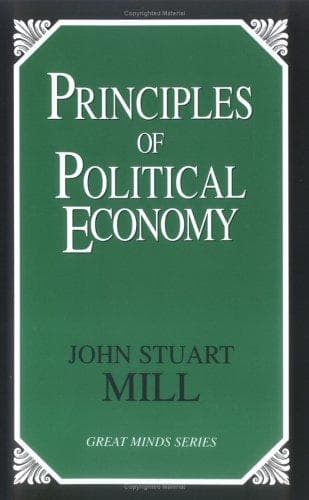
Principles of Political Economy: Abridged with Critical, Bibliographical, and Explanatory Notes, and a Sketch of the History of Political EconomyMill, John Stuart
PhilosophyPhilosophy
Principles of Political Economy: Abridged with Critical, Bibliographical, and Explanatory Notes, and a Sketch of the History of Political Economy
Mill, John Stuart
Economics
If, therefore, the choice were to be made between Communism with all its
chances and the present state of society with all its sufferings and
injustices, all the difficulties, great or small, of Communism, would be
but as dust in the balance. But, to make the comparison applicable, we
must compare Communism at its best with the _régime_ of individual
property, not as it is, but as it might be made. The laws of property have
never yet conformed to the principles on which the justification of
private property rests. They have made property of things which never
ought to be property, and absolute property where only a qualified
property ought to exist. Private property, in every defense made of it, is
supposed to mean the guarantee to individuals of the fruits of their own
labor and abstinence. The guarantee to them of the fruits of the labor and
abstinence of others, transmitted to them without any merit or exertion of
their own, is not of the essence of the institution, but a mere incidental
consequence, which, when it reaches a certain height, does not promote,
but conflicts with the ends which render private property legitimate. To
judge of the final destination of the institution of property, we must
suppose everything rectified which causes the institution to work in a
manner opposed to that equitable principle, of proportion between
remuneration and exertion, on which, in every vindication of it that will
bear the light, it is assumed to be grounded. We must also suppose two
conditions realized, without which neither Communism nor any other laws or
institutions could make the condition of the mass of mankind other than
degraded and miserable. One of these conditions is, universal education;
the other, a due limitation of the numbers of the community. With these,
there could be no poverty, even under the present social institutions:
and, these being supposed, the question of socialism is not, as generally
stated by Socialists, a question of flying to the sole refuge against the
evils which now bear down humanity, but a mere question of comparative
advantages, which futurity must determine. We are too ignorant either of
what individual agency in its best form, or socialism in its best form,
can accomplish, to be qualified to decide which of the two will be the
ultimate form of human society.
Public-domain text, read in full here on John Shaqi.
Reviews
Reviews
No reviews yet
Be the first to share your thoughts on this work.
Elsewhere in the archive
Join the Discussion
Join the discussion
Sign in to leave a comment or review.
Sign InorCreate an account