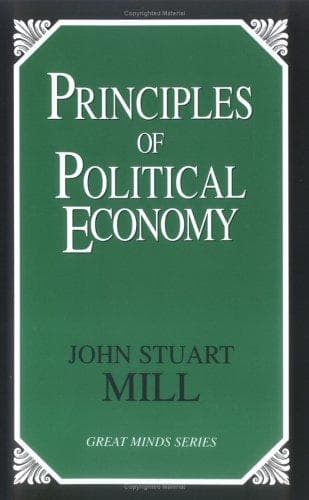
Principles of Political Economy: Abridged with Critical, Bibliographical, and Explanatory Notes, and a Sketch of the History of Political EconomyMill, John Stuart
PhilosophyPhilosophy
Principles of Political Economy: Abridged with Critical, Bibliographical, and Explanatory Notes, and a Sketch of the History of Political Economy
Mill, John Stuart
Economics
If a conjecture may be hazarded, the decision will probably depend mainly
on one consideration, viz., which of the two systems is consistent with
the greatest amount of human liberty and spontaneity. It is yet to be
ascertained whether the communistic scheme would be consistent with that
multiform development of human nature, those manifold unlikenesses, that
diversity of tastes and talents, and variety of intellectual points of
view, which not only form a great part of the interest of human life, but,
by bringing intellects into stimulating collision and by presenting to
each innumerable notions that he would not have conceived of himself, are
the mainspring of mental and moral progression.
§ 3. The Socialists who appeal to state-help.
For general purposes, a clearer understanding of the various
schemes may be gained by observing that (1) one class of
socialists intend to include the state itself within their plan,
and (2) another class aim to form separate communities inside the
state, and under its protection.
Of this first system there are no present examples; but the object
of most of the socialistic organizations in the United States and
Europe is to strive for the assumption by the state of the
production and distribution of wealth.(147) At present the most
active Socialists are to be found in Germany. The origin of this
influence, however, is to be traced to France.(148) Louis
Blanc,(149) in his “Organisation du Travail,” considers property
the great scourge of society. The Government, he asserts, should
regulate production; raise money to be appropriated without
interest for creating state workshops, in which the workmen should
elect their own overseers, and all receive the same wages; and the
sums needed should be raised from the abolition of collateral
inheritance. The important practical part of his scheme was that
the great state workshops, aided by the Government, would make
private competition in those industries impossible, and thus bring
about the change from the private to the socialistic system.
Public-domain text, read in full here on John Shaqi.
Reviews
Reviews
No reviews yet
Be the first to share your thoughts on this work.
Elsewhere in the archive
Join the Discussion
Join the discussion
Sign in to leave a comment or review.
Sign InorCreate an account