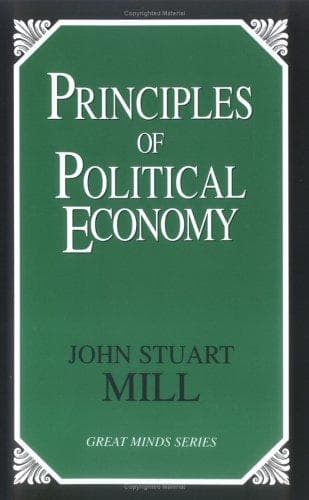
Principles of Political Economy: Abridged with Critical, Bibliographical, and Explanatory Notes, and a Sketch of the History of Political EconomyMill, John Stuart
PhilosophyPhilosophy
Principles of Political Economy: Abridged with Critical, Bibliographical, and Explanatory Notes, and a Sketch of the History of Political Economy
Mill, John Stuart
Economics
I. Labor is the source of all riches and of all culture. As
general profitable labor can only be done by the human society,
the whole product of labor belongs to society—i.e., to all its
members—who have the same duties and the same right to work, each
according to his reasonable wants.
In the present society the means of work are the monopoly of the
class of capitalists. The class of workingmen thus become
dependent on them, and consequently are given over to all degrees
of misery and servitude.
In order to emancipate labor it is requisite that the means of
work be transformed into the common property of society, that all
production be regulated by associations, and that the entire
product of labor be turned over to society and justly distributed
for the benefit of all.
None but the working-class itself can emancipate labor, as in
relation to it all other classes are only a reactionary mass.
II. Led by these principles, the German Social Workingmen’s party,
by all legal means, strives for a free state and society, the
breaking down of the iron laws of wages by abolishing the system
of hired workingmen, by abolishing exploitation in every shape,
and doing away with all social and political inequality.
The German Social Workingmen’s party, although first working
within its national confines, is fully conscious of the
international character of the general workingmen’s movement, and
is resolved to fulfill all duties which it imposes on each
workingman in order to realize the fraternity of all men.
The German Social Workingmen’s party, for the purpose of preparing
the way, and for the solution of the social problem, demands the
creation of social productive associations, to be supported by the
state government, and under the control of the working-people. The
productive associations are to be founded in such numbers that the
social organization of the whole production can be effected by
them.
The German Social Workingmen’s party requires as the basis of
state government:
1. Universal, equal, direct, and secret suffrage, which, beginning
with the twentieth year, obliges all citizens to vote in all
State, county, and town elections. Election-day must be a Sunday
or a holiday.
2. Direct legislation by the people; decision as to war and peace
by the people.
3. General capability of bearing arms; popular defense in place of
standing armies.
4. Abolition of all exceptional laws, especially those relating to
the press, public meetings, and associations—in short, of all laws
which hinder the free expression of ideas and thought.
5. Gratuitous administration of justice by the people.
Public-domain text, read in full here on John Shaqi.
Reviews
Reviews
No reviews yet
Be the first to share your thoughts on this work.
Elsewhere in the archive
Join the Discussion
Join the discussion
Sign in to leave a comment or review.
Sign InorCreate an account