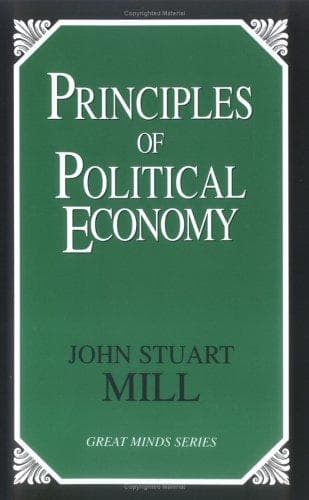
Principles of Political Economy: Abridged with Critical, Bibliographical, and Explanatory Notes, and a Sketch of the History of Political EconomyMill, John Stuart
PhilosophyPhilosophy
Principles of Political Economy: Abridged with Critical, Bibliographical, and Explanatory Notes, and a Sketch of the History of Political Economy
Mill, John Stuart
Economics
The founder of modern German socialism was Karl Marx,(150) and
almost the only Socialist who pretended to economic knowledge. He
aimed his attack on the present social system against the question
of value, by asserting that the amount of labor necessary for the
production of an article is the sole measure of its exchange
value. It follows from this that the right of property in the
article vests wholly in the laborer, while the capitalist, if he
claims a share of the product, is nothing less than a robber. No
just system, he avers, can properly exist so long as the rate of
wages is fixed by free contract between the employer and laborer;
therefore the only remedy is the nationalization of all the
elements of production, land, tools, materials, and all existing
appliances, which involves, of course, the destruction of the
institution of private property. An obvious weakness in this
scheme is the provision that the Government should determine what
goods are to be produced, and that every one is bound to perform
that work which is assigned by the state. In this there is no
choice of work, and the tyranny of one master would be supplanted
by the tyranny of a greater multiplex master in the officers of
Government. Moreover, it can not be admitted that exchange value
is determined by the quantity of labor alone. Every one knows that
the result of ten days’ labor of a skilled watch-maker does not
exchange for the result of ten days’ labor of an unskilled hodman.
Of two men making shoes, one may produce a good the other a poor
article, although both may work the same length of time; so that
their exchange value ought not to be determined by the mere
quantity of labor expended. Above all, Marx would extend the
equality of wages for the same time to the manager and
superintendent also. In other words, he proposes to take away all
the incentives to the acquirement or exercise of superior and
signal ability in every work of life, the result of which would
inevitably lead to a deadening extension of mediocrity.
This system gained an undue attention because it was made the
instrument of a socialist propaganda under the leadership of
Ferdinand Lassalle.(151) This active leader, in 1863, founded the
German “Workingmen’s Union,” a year earlier than the
“International(152) Association.” In 1869 Liebknecht and his
friends established the “Social Democratic Workingmen’s Party,”
which after some difficulties absorbed the followers of Lassalle
in a congress at Gotha in 1875, and form the present Socialist
party in Germany. Their programme,(153) as announced at Gotha, is
as follows:
Public-domain text, read in full here on John Shaqi.
Reviews
Reviews
No reviews yet
Be the first to share your thoughts on this work.
Elsewhere in the archive
Join the Discussion
Join the discussion
Sign in to leave a comment or review.
Sign InorCreate an account