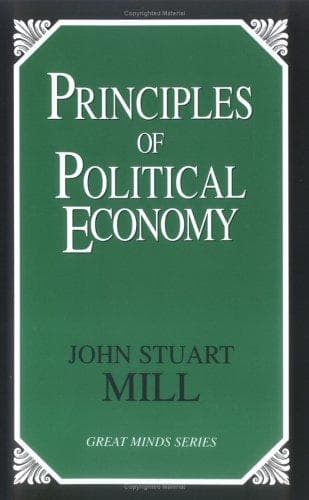
Principles of Political Economy: Abridged with Critical, Bibliographical, and Explanatory Notes, and a Sketch of the History of Political EconomyMill, John Stuart
PhilosophyPhilosophy
Principles of Political Economy: Abridged with Critical, Bibliographical, and Explanatory Notes, and a Sketch of the History of Political Economy
Mill, John Stuart
Economics
“M. Louis Blanc appears to have fallen into the same error which was at
first committed by Malthus and his followers, that of supposing because
population has a greater power of increase than subsistence, its pressure
upon subsistence must be always growing more severe. It is a great point
gained for truth when it comes to be seen that the tendency to
over-population is a fact which Communism, as well as the existing order
of society, would have to deal with. However this may be, experience shows
that in the existing state of society the pressure of population on
subsistence, which is the principal cause of low wages, though a great, is
not an increasing evil; on the contrary, the progress of all that is
called civilization has a tendency to diminish it, partly by the more
rapid increase of the means of employing and maintaining labor, partly by
the increased facilities opened to labor for transporting itself to new
countries and unoccupied fields of employment, and partly by a general
improvement in the intelligence and prudence of the population. It is, of
course, open to discussion what form of society has the greatest power of
dealing successfully with the pressure of population on subsistence, and
on this question there is much to be said for Socialism; but it has no
just claim to be considered as the sole means of preventing the general
and growing degradation of the mass of mankind through the peculiar
tendency of poverty to produce over-population.
“Next, it must be observed that Socialists generally, and even the most
enlightened of them, have a very imperfect and one-sided notion of the
operation of competition. They see half its effects, and overlook the
other half. They forget that competition is a cause of high prices and
values as well as of low; that the buyers of labor and of commodities
compete with one another as well as the sellers; and that, if it is
competition which keeps the prices of labor and commodities as low as they
are, it is competition which keeps them from falling still lower. To meet
this consideration, Socialists are reduced to affirm that, when the
richest competitor has got rid of all his rivals, he commands the market
and can demand any price he pleases. But in the ordinary branches of
industry no one rich competitor has it in his power to drive out all the
smaller ones. Some businesses show a tendency to pass out of the hands of
small producers or dealers into a smaller number of larger ones; but the
cases in which this happens are those in which the possession of a larger
capital permits the adoption of more powerful machinery, more efficient by
more expensive processes, or a better organized and more economical mode
of carrying on business, and this enables the large dealer legitimately
and permanently to supply the commodity cheaper than can be done on the
small scale; to the great advantage of the consumers, and therefore of the
laboring-classes, and diminishing, _pro tanto_, that waste of the
Public-domain text, read in full here on John Shaqi.
Reviews
Reviews
No reviews yet
Be the first to share your thoughts on this work.
Elsewhere in the archive
Join the Discussion
Join the discussion
Sign in to leave a comment or review.
Sign InorCreate an account