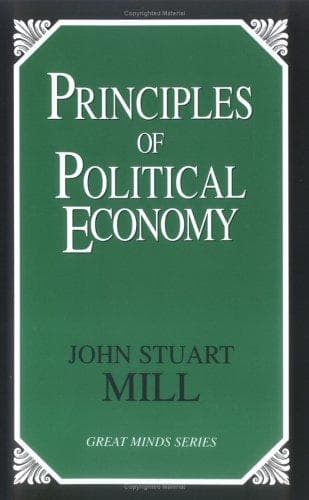
Principles of Political Economy: Abridged with Critical, Bibliographical, and Explanatory Notes, and a Sketch of the History of Political EconomyMill, John Stuart
PhilosophyPhilosophy
Principles of Political Economy: Abridged with Critical, Bibliographical, and Explanatory Notes, and a Sketch of the History of Political Economy
Mill, John Stuart
Economics
resources of the community so much complained of by Socialists, the
unnecessary multiplication of mere distributors, and of the various other
classes whom Fourier calls the parasites of industry.
“Another point on which there is much misapprehension on the part of
Socialists, as well as of trades-unionists and other partisans of labor
against capital, relates to the proportion in which the produce of the
country is really shared and the amount of what is actually diverted from
those who produce it, to enrich other persons. When, for instance, a
capitalist invests £20,000 in his business, and draws from it an income of
(suppose) £2,000 a year, the common impression is as if he were the
beneficial owner both of the £20,000 and of the £2,000, while the laborers
own nothing but their wages. The truth, however, is that he only obtains
the £2,000 on condition of applying no part of the £20,000 to his own use.
He has the legal control over it, and might squander it if he chose, but
if he did he would not have the £2,000 a year also. For all personal
purposes they have the capital and he has but the profits, which it only
yields to him on condition that the capital itself is employed in
satisfying not his own wants, but those of laborers. Even of his own share
a small part only belongs to him as the owner of capital. The portion of
the produce which falls to capital merely as capital is measured by the
interest of money, since that is all that the owner of capital obtains
when he contributes to production nothing except the capital itself.
“The result of our review of the various difficulties of Socialism has led
us to the conclusion that the various schemes for managing the productive
resources of the country by public instead of private agency have a case
for a trial, and some of them may eventually establish their claims to
preference over the existing order of things, but that they are at present
workable only by the _élite_ of mankind, and have yet to prove their power
of training mankind at large to the state of improvement which they
presuppose.”
§ 6. Property in land different from property in Movables.
It is next to be considered what is included in the idea of private
property and by what considerations the application of the principle
should be bounded.
Public-domain text, read in full here on John Shaqi.
Reviews
Reviews
No reviews yet
Be the first to share your thoughts on this work.
Elsewhere in the archive
Join the Discussion
Join the discussion
Sign in to leave a comment or review.
Sign InorCreate an account