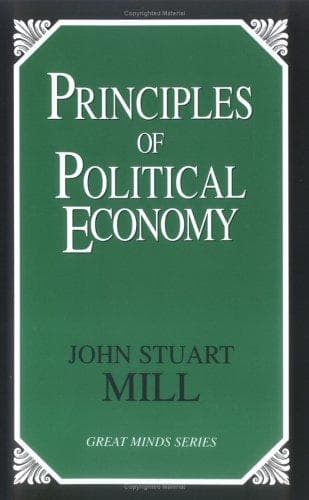
Principles of Political Economy: Abridged with Critical, Bibliographical, and Explanatory Notes, and a Sketch of the History of Political EconomyMill, John Stuart
PhilosophyPhilosophy
Principles of Political Economy: Abridged with Critical, Bibliographical, and Explanatory Notes, and a Sketch of the History of Political Economy
Mill, John Stuart
Economics
the accumulation of capital and the expectation of profit. Circle
B contracts and expands under influences which have nothing to do
with the immediate bargains between capitalists and laborers. (2.)
Another influence now comes in to affect the amount of capital
actually paid as wages, one also governed by general causes
outside the reach of laborer or capitalist, that is, the state of
the arts of production. In production, the particular conditions
of each industry will determine how much capital is to be set
apart for raw material, how much for machinery, buildings, and all
forms of fixed capital, and how many laborers will be assigned to
a given machine for a given amount of material. With some kinds of
hand-made goods the largest share of capital goes to wages, a less
amount for materials, and a very small proportion for machinery
and tools. In many branches of agriculture and small farming this
holds true. The converse, however, is true in many manufactures,
where machinery is largely used. No two industries will maintain
the same proportion between the three elements. The nature of the
industry, therefore, will determine whether a greater or a less
share of capital will be spent in wages. It is needless to say
that this condition of things is not one to be changed at the
demand of either of the two parties to production, Labor and
Capital; it responds only to the advance of mechanical science or
general intelligence. It is impossible, then, to escape the
conclusion that general causes restrict the amount which will,
under any normal investment, go to the payment of wages. Only
within the limits set by these forces can any further expansion or
contraction take place. (3.) Within these limits, of course, minor
changes may take place, so that the fund can not be said to be
“fixed” or “absolutely predetermined”; but these changes must take
place within such narrow limits that they do not much affect the
practical side of the question. How these changes act, may be seen
in a part of the following illustration of the above principles:
Public-domain text, read in full here on John Shaqi.
Reviews
Reviews
No reviews yet
Be the first to share your thoughts on this work.
Elsewhere in the archive
Join the Discussion
Join the discussion
Sign in to leave a comment or review.
Sign InorCreate an account