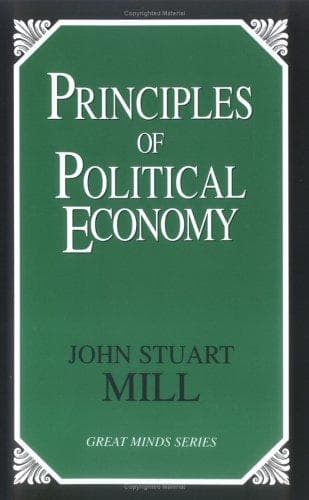
Principles of Political Economy: Abridged with Critical, Bibliographical, and Explanatory Notes, and a Sketch of the History of Political EconomyMill, John Stuart
PhilosophyPhilosophy
Principles of Political Economy: Abridged with Critical, Bibliographical, and Explanatory Notes, and a Sketch of the History of Political Economy
Mill, John Stuart
Economics
Suppose a cotton-mill established in one of the valleys of
Vermont, for the management of which the owner has $140,000 of
capital. Of this, $100,000 is given for buildings, machinery, and
plant. If he turns over his remaining capital ($40,000) each
month, we will suppose that $28,000 spent in raw materials will
keep five hundred men occupied at a monthly expenditure of
$12,000. The present state of cotton-manufacture itself settles
the relation between a given quantity of raw cotton and a certain
amount of machinery. A fixed amount of cotton, no more, no less,
can be spun by each spindle and woven by each loom; and the nature
of the process determines the number of laborers to each machine.
This proportion is something which an owner must obey, if he
expects to compete with other manufacturers: the relationship is
fixed for, not by, him. Now, each of the five hundred laborers
being supposed to receive on an average $1.00 a day, imagine an
influx of a body of French Canadians who offer to work, on an
average, for eighty cents a day.(165) The five hundred men will
now receive but $9,600 monthly instead of $12,000, as before, as a
wages-fund; the monthly payment for wages now is nearly seven per
cent, while formerly it was nearly nine per cent of the total
capital invested ($140,000). Thus it will be seen that the
wages-fund can change with a change in the supply of labor: but
the point to be noticed is that it is a change in the subdivision,
$12,000, of the total $140,000. That is, this alteration can take
place only within the limits set by the nature of the industry.
Now, if this $2,400 (i.e., $12,000 less $9,600) saved out of the
wages-fund were to be reinvested, it must necessarily be divided
between raw materials, fixed capital, and wages in the existing
relations, that is, only seven per cent of the new $2,400 would be
added to the wages-fund. It is worth while calling attention to
this, if for no other reason than to show that in this way a
change can be readily made in the wages-fund by natural movements;
and that no one can be so absurd as to say that it is absolutely
fixed in amount. But it certainly is “predetermined” in the
economic sense, in that any reinvestments, as well as former
funds, must necessarily be distributed according to the above
general principles, independent of the “higgling” in the labor
market. The following is Mr. Cairnes’s statement of the amount and
“predetermination” of the wages-fund:
Public-domain text, read in full here on John Shaqi.
Reviews
Reviews
No reviews yet
Be the first to share your thoughts on this work.
Elsewhere in the archive
Join the Discussion
Join the discussion
Sign in to leave a comment or review.
Sign InorCreate an account