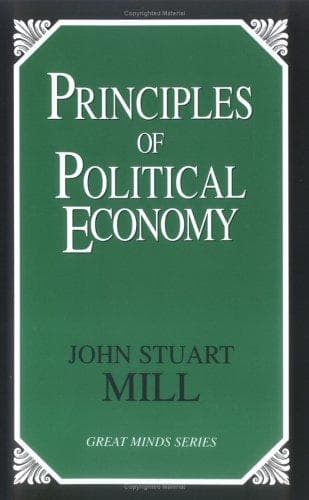
Principles of Political Economy: Abridged with Critical, Bibliographical, and Explanatory Notes, and a Sketch of the History of Political EconomyMill, John Stuart
PhilosophyPhilosophy
Principles of Political Economy: Abridged with Critical, Bibliographical, and Explanatory Notes, and a Sketch of the History of Political Economy
Mill, John Stuart
Economics
habitual among the laborers, a rise of the price of food, or any other
disadvantageous change in their circumstances, may operate in two ways:
(_a_) it may correct itself by a rise of wages, brought about through a
gradual effect on the prudential check to population; or (_b_) it may
permanently lower the standard of living of the class, in case their
previous habits in respect of population prove stronger than their
previous habits in respect of comfort. In that case the injury done to
them will be permanent, and their deteriorated condition will become a new
minimum, tending to perpetuate itself as the more ample minimum did
before. It is to be feared that, of the two modes in which the cause may
operate, the last (_b_) is the most frequent, or at all events
sufficiently so to render all propositions, ascribing a self-repairing
quality to the calamities which befall the laboring-classes, practically
of no validity.
The converse case occurs when, by improvements in agriculture, the repeal
of corn laws, or other such causes, the necessaries of the laborers are
cheapened, and they are enabled with the same [money] wages to command
greater comforts than before. Wages will not fall immediately: it is even
possible that they may rise; but they will fall at last, so as to leave
the laborers no better off than before, unless during this interval of
prosperity the standard of comfort regarded as indispensable by the class
is permanently raised. Unfortunately this salutary effect is by no means
to be counted upon: it is a much more difficult thing to raise, than to
lower, the scale of living which the laborers will consider as more
indispensable than marrying and having a family. According to all
experience, a great increase invariably takes place in the number of
marriages in seasons of cheap food and full employment.
This is to be seen by some brief statistics of marriages in
Vermont and Massachusetts.
Year. Vermont Massachusetts
1860 2,179 12,404
1861 2,188 10,972
1862 1,962 11,014
1863 2,007 10,873
1864 1,804 12,513
1865 2,569 13,052
1866 3,001 14,428
1867 2,857 14,451
In Vermont, while the average number of marriages was reached in
1860 and 1861, it fell off on the breaking out of the war; rose in
1863, under the fair progress of the Northern arms; again fell off
in 1864, during the period of discouragement; and since 1865 has
kept a steadily higher average. In manufacturing Massachusetts the
number fell earlier than in agricultural Vermont, at the beginning
of the difficulties.
1856, July to Jan. 6,418
1857, Jan. to July 5,803
1857, July to Jan. 5,936
1858, Jan. to July 4,917
1858, July to Jan. 5,610
Public-domain text, read in full here on John Shaqi.
Reviews
Reviews
No reviews yet
Be the first to share your thoughts on this work.
Elsewhere in the archive
Join the Discussion
Join the discussion
Sign in to leave a comment or review.
Sign InorCreate an account