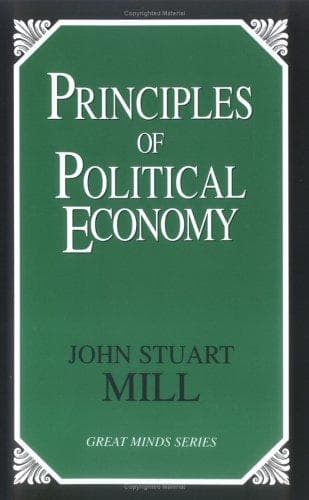
Principles of Political Economy: Abridged with Critical, Bibliographical, and Explanatory Notes, and a Sketch of the History of Political EconomyMill, John Stuart
PhilosophyPhilosophy
Principles of Political Economy: Abridged with Critical, Bibliographical, and Explanatory Notes, and a Sketch of the History of Political Economy
Mill, John Stuart
Economics
When reference is had to the connection between real wages and
prices, the question is a different one. General high prices would
not change general _real wages_. But if high prices cause higher
money wages in particular branches of trade, then, because the
movement is not general, there will accrue, to those receiving
more money, the means to buy more of real wages. And, as in
practice, changes in prices which arise from an increased demand
are partial, and not general, it often happens that high prices
produce high real wages (not general high wages) in some, not in
all employments. (For a further study of this relation between
prices and wages the reader is advised to recall this discussion
in connection with that in a later part of the volume, Book III,
Chaps. XX and XXI.)
3. Another opinion often maintained is, that wages (meaning of course
money wages) vary with the price of food; rising when it rises, and
falling when it falls. This opinion is, I conceive, only partially true;
and, in so far as true, in no way affects the dependence of wages on the
proportion between capital and labor: since the price of food, when it
affects wages at all, affects them through that law. Dear or cheap food
caused by variety of seasons does not affect wages (unless they are
artificially adjusted to it by law or charity): or rather, it has some
tendency to affect them in the contrary way to that supposed; since in
times of scarcity people generally compete more violently for employment,
and lower the labor market against themselves. But dearness or cheapness
of food, when of a permanent character, and capable of being calculated on
beforehand, may affect wages. (1.) In the first place, if the laborers
have, as is often the case, no more than enough to keep them in working
condition and enable them barely to support the ordinary number of
children, it follows that, if food grows permanently dearer without a rise
of wages, a greater number of the children will prematurely die; and thus
wages will ultimately be higher, but only because the number of people
will be smaller, than if food had remained cheap. (2.) But, secondly, even
though wages were high enough to admit of food’s becoming more costly
without depriving the laborers and their families of necessaries; though
they could bear, physically speaking, to be worse off, perhaps they would
not consent to be so. They might have habits of comfort which were to them
as necessaries, and sooner than forego which, they would put an additional
restraint on their power of multiplication; so that wages would rise, not
by increase of deaths but by diminution of births. In these cases, then,
wages do adapt themselves to the price of food, though after an interval
of almost a generation.(170) If wages were previously so high that they
could bear reduction, to which the obstacle was a high standard of comfort
Public-domain text, read in full here on John Shaqi.
Reviews
Reviews
No reviews yet
Be the first to share your thoughts on this work.
Elsewhere in the archive
Join the Discussion
Join the discussion
Sign in to leave a comment or review.
Sign InorCreate an account