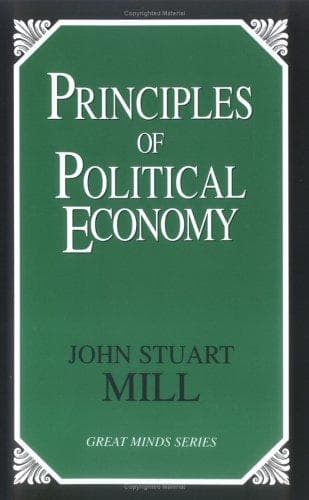
Principles of Political Economy: Abridged with Critical, Bibliographical, and Explanatory Notes, and a Sketch of the History of Political EconomyMill, John Stuart
PhilosophyPhilosophy
Principles of Political Economy: Abridged with Critical, Bibliographical, and Explanatory Notes, and a Sketch of the History of Political Economy
Mill, John Stuart
Economics
In countries like North America and the Australian colonies, where the
knowledge and arts of civilized life and a high effective desire of
accumulation coexist with a boundless extent of unoccupied land, the
growth of capital easily keeps pace with the utmost possible increase of
population, and is chiefly retarded by the impracticability of obtaining
laborers enough. All, therefore, who can possibly be born can find
employment without overstocking the market: every laboring family enjoys
in abundance the necessaries, many of the comforts, and some of the
luxuries of life; and, unless in case of individual misconduct, or actual
inability to work, poverty does not, and dependence need not, exist. [In
England] so gigantic has been the progress of the cotton manufacture since
the inventions of Watt and Arkwright, that the capital engaged in it has
probably quadrupled in the time which population requires for doubling.
While, therefore, it has attracted from other employments nearly all the
hands which geographical circumstances and the habits or inclinations of
the people rendered available; and while the demand it created for infant
labor has enlisted the immediate pecuniary interest of the operatives in
favor of promoting, instead of restraining, the increase of population;
nevertheless wages in the great seats of the manufacture are still so high
that the collective earnings of a family amount, on an average of years,
to a very satisfactory sum; and there is as yet no sign of decrease, while
the effect has also been felt in raising the general standard of
agricultural wages in the counties adjoining.
But those circumstances of a country, or of an occupation, in which
population can with impunity increase at its utmost rate, are rare and
transitory. Very few are the countries presenting the needful union of
conditions. Either the industrial arts are backward and stationary, and
capital therefore increases slowly, or, the effective desire of
accumulation being low, the increase soon reaches its limit; or, even
though both these elements are at their highest known degree, the increase
of capital is checked, because there is not fresh land to be resorted to
of as good quality as that already occupied. Though capital should for a
time double itself simultaneously with population, if all this capital and
population are to find employment on the same land, they can not, without
an unexampled succession of agricultural inventions, continue doubling the
produce; therefore, if wages do not fall, profits must; and, when profits
fall, increase of capital is slackened.
Public-domain text, read in full here on John Shaqi.
Reviews
Reviews
No reviews yet
Be the first to share your thoughts on this work.
Elsewhere in the archive
Join the Discussion
Join the discussion
Sign in to leave a comment or review.
Sign InorCreate an account