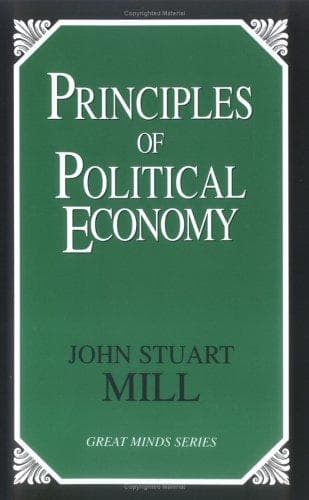
Principles of Political Economy: Abridged with Critical, Bibliographical, and Explanatory Notes, and a Sketch of the History of Political EconomyMill, John Stuart
PhilosophyPhilosophy
Principles of Political Economy: Abridged with Critical, Bibliographical, and Explanatory Notes, and a Sketch of the History of Political Economy
Mill, John Stuart
Economics
Except, therefore, in the very peculiar cases which I have just noticed,
of which the only one of any practical importance is that of a new colony,
or a country in circumstances equivalent to it, it is impossible that
population should increase at its utmost rate without lowering wages. In
no old country does population increase at anything like its utmost rate;
in most, at a very moderate rate: in some countries, not at all. These
facts are only to be accounted for in two ways. Either the whole number of
births which nature admits of, and which happen in some circumstances, do
not take place; or, if they do, a large proportion of those who are born,
die. The retardation of increase results either from mortality or
prudence; from Mr. Malthus’s positive, or from his preventive check: and
one or the other of these must and does exist, and very powerfully too, in
all old societies. Wherever population is not kept down by the prudence
either of individuals or of the state, it is kept down by starvation or
disease.
§ 5. Due Restriction of Population the only Safeguard of a Laboring-Class.
Where a laboring-class who have no property but their daily wages, and no
hope of acquiring it, refrain from over-rapid multiplication, the cause, I
believe, has always hitherto been, either actual legal restraint, or a
custom of some sort which, without intention on their part, insensibly
molds their conduct, or affords immediate inducements not to marry. It is
not generally known in how many countries of Europe direct legal obstacles
are opposed to improvident marriages.
Where there is no general law restrictive of marriage, there are often
customs equivalent to it. When the guilds or trade corporations of the
middle ages were in vigor, their by-laws or regulations were conceived
with a very vigilant eye to the advantage which the trade derived from
limiting competition; and they made it very effectually the interest of
artisans not to marry until after passing through the two stages of
apprentice and journeyman, and attaining the rank of master.
Unhappily, sentimentality rather than common sense usually presides over
the discussions of these subjects. Discussions on the condition of the
laborers, lamentations over its wretchedness, denunciations of all who are
supposed to be indifferent to it, projects of one kind or another for
improving it, were in no country and in no time of the world so rife as in
the present generation; but there is a tacit agreement to ignore totally
the law of wages, or to dismiss it in a parenthesis, with such terms as
“hard-hearted Malthusianism”; as if it were not a thousand times more
hard-hearted to tell human beings that they may, than that they may not,
call into existence swarms of creatures who are sure to be miserable, and
most likely to be depraved!
Public-domain text, read in full here on John Shaqi.
Reviews
Reviews
No reviews yet
Be the first to share your thoughts on this work.
Elsewhere in the archive
Join the Discussion
Join the discussion
Sign in to leave a comment or review.
Sign InorCreate an account