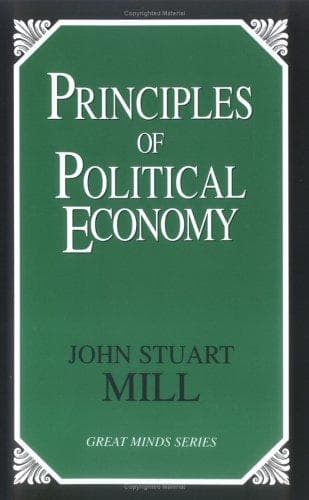
Principles of Political Economy: Abridged with Critical, Bibliographical, and Explanatory Notes, and a Sketch of the History of Political EconomyMill, John Stuart
PhilosophyPhilosophy
Principles of Political Economy: Abridged with Critical, Bibliographical, and Explanatory Notes, and a Sketch of the History of Political Economy
Mill, John Stuart
Economics
The famous poor-laws of Elizabeth, enacted in 1601, were at first
intended to relieve the destitute poor, sick, aged, and impotent,
but in their administration a share was given to all who _begged_
it. Employers, of course, found it cheaper to hire labor partly
paid for by the parish, and the independent farm-laborer who would
not go on the parish found his own wages lowered by this kind of
competition. This continued a crying evil until it reached the
proportions described by May: “As the cost of pauperism, thus
encouraged, was increasing, the poorer rate-payers were themselves
reduced to poverty. The soil was ill-cultivated by pauper labor,
and its rental consumed by parish rates. In a period of fifty
years, the poor-rates were quadrupled, and had reached, in 1833,
the enormous amount of £8,600,000. In many parishes they were
approaching the annual value of the land itself.”(173) The old
poor-laws were repealed, and there went into effect in 1834 the
workhouse system, which, while not denying subsistence to all
those born, required that the giving of aid should be made as
disagreeable as possible, in order to stimulate among the poor a
feeling of repugnance to all aid from the community. This is also
the general idea of poor-relief in the United States.
The cultivation of the principle of self-help in each laborer is
certainly the right object at which to aim. In the United States
voluntary charitable organizations have associated together, in
some cities, in order to scrutinize all cases of poverty through a
number of visitors in each district, who advise and counsel the
unfortunate, but never give money. This system has been very
successful, and, by basing its operations on the principle of
self-help, has given the best proof of its right to an increasing
influence.
§ 3. Allowances in Aid of Wages and the Standard of Living.
Next to the attempts to regulate wages, and provide artificially that all
who are willing to work shall receive an adequate price for their labor,
we have to consider another class of popular remedies, which do not
profess to interfere with freedom of contract; which leave wages to be
fixed by the competition of the market, but, when they are considered
insufficient, endeavor by some subsidiary resource to make up to the
laborers for the insufficiency. Of this nature was the allowance system.
The principle of this scheme being avowedly that of adapting the means of
every family to its necessities, it was a natural consequence that more
should be given to the married than to the single, and to those who had
large families than to those who had not: in fact, an allowance was
usually granted for every child. It is obvious that this is merely another
mode of fixing a minimum of wages.
Public-domain text, read in full here on John Shaqi.
Reviews
Reviews
No reviews yet
Be the first to share your thoughts on this work.
Elsewhere in the archive
Join the Discussion
Join the discussion
Sign in to leave a comment or review.
Sign InorCreate an account