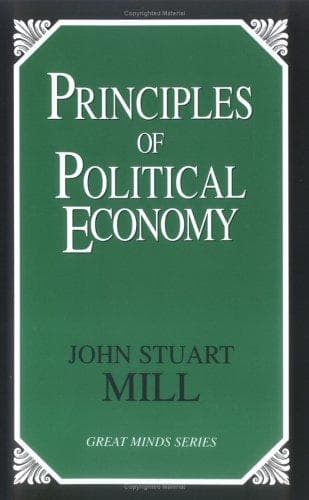
Principles of Political Economy: Abridged with Critical, Bibliographical, and Explanatory Notes, and a Sketch of the History of Political EconomyMill, John Stuart
PhilosophyPhilosophy
Principles of Political Economy: Abridged with Critical, Bibliographical, and Explanatory Notes, and a Sketch of the History of Political Economy
Mill, John Stuart
Economics
If this claim on society could be limited to the existing generation; if
nothing more were necessary than a compulsory accumulation, sufficient to
provide permanent employment at ample wages for the existing numbers of
the people; such a proposition would have no more strenuous supporter than
myself. Society mainly consists of those who live by bodily labor; and if
society, that is, if the laborers, lend their physical force to protect
individuals in the enjoyment of superfluities, they are entitled to do so,
and have always done so, with the reservation of a power to tax those
superfluities for purposes of public utility; among which purposes the
subsistence of the people is the foremost. Since no one is responsible for
having been born, no pecuniary sacrifice is too great to be made by those
who have more than enough, for the purpose of securing enough to all
persons already in existence.
But it is another thing altogether when those who have produced and
accumulated are called upon to abstain from consuming until they have
given food and clothing, not only to all who now exist, but to all whom
these or their descendants may think fit to call into existence. Such an
obligation acknowledged and acted upon, would suspend all checks, both
positive and preventive; there would be nothing to hinder population from
starting forward at its rapidest rate; and as the natural increase of
capital would, at the best, not be more rapid than before, taxation, to
make up the growing deficiency, must advance with the same gigantic
strides. But let them work ever so efficiently, the increasing population
could not, as we have so often shown, increase the produce proportionally;
the surplus, after all were fed, would bear a less and less proportion to
the whole produce and to the population: and the increase of people going
on in a constant ratio, while the increase of produce went on in a
diminishing ratio, the surplus would in time be wholly absorbed; taxation
for the support of the poor would engross the whole income of the country;
the payers and the receivers would be melted down into one mass.
It would be possible for the state to guarantee employment at ample wages
to all who are born. But if it does this, it is bound in self-protection,
and for the sake of every purpose for which government exists, to provide
that no person shall be born without its consent. To give profusely to the
people, whether under the name of charity or of employment, without
placing them under such influences that prudential motives shall act
powerfully upon them, is to lavish the means of benefiting mankind without
attaining the object. But remove the regulation of their wages from their
own control; guarantee to them a certain payment, either by law or by the
feeding of the community; and no amount of comfort that you can give them
will make either them or their descendants look to their own
self-restraint as the proper means for preserving them in that state.
Public-domain text, read in full here on John Shaqi.
Reviews
Reviews
No reviews yet
Be the first to share your thoughts on this work.
Elsewhere in the archive
Join the Discussion
Join the discussion
Sign in to leave a comment or review.
Sign InorCreate an account