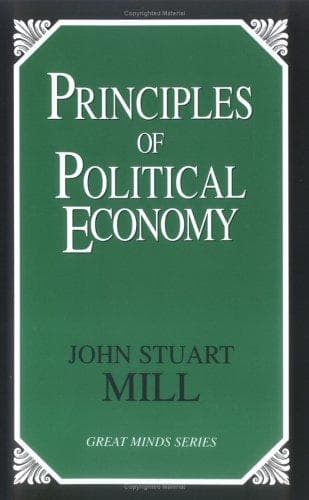
Principles of Political Economy: Abridged with Critical, Bibliographical, and Explanatory Notes, and a Sketch of the History of Political EconomyMill, John Stuart
PhilosophyPhilosophy
Principles of Political Economy: Abridged with Critical, Bibliographical, and Explanatory Notes, and a Sketch of the History of Political Economy
Mill, John Stuart
Economics
By what means, then, is poverty to be contended against? How is the evil
of low wages to be remedied? If the expedients usually recommended for the
purpose are not adapted to it, can no others be thought of? Is the problem
incapable of solution? Can political economy do nothing, but only object
to everything, and demonstrate that nothing can be done? Those who think
it hopeless that the laboring-classes should be induced to practice a
sufficient degree of prudence in regard to the increase of their families,
because they have hitherto stopped short of that point, show an inability
to estimate the ordinary principles of human action. Nothing more would
probably be necessary to secure that result, than an opinion generally
diffused that it was desirable.
But let us try to imagine what would happen if the idea became general
among the laboring-class that the competition of too great numbers was the
principal cause of their poverty. We are often told that the most thorough
perception of the dependence of wages on population will not influence the
conduct of a laboring-man, because it is not the children he himself can
have that will produce any effect in generally depressing the labor
market. True, and it is also true that one soldier’s running away will not
lose the battle; accordingly, it is not that consideration which keeps
each soldier in his rank: it is the disgrace which naturally and
inevitably attends on conduct by any one individual which, if pursued by a
majority, everybody can see would be fatal. Men are seldom found to brave
the general opinion of their class, unless supported either by some
principle higher than regard for opinion, or by some strong body of
opinion elsewhere.
If the opinion were once generally established among the laboring-class
that their welfare required a due regulation of the numbers of families,
the respectable and well-conducted of the body would conform to the
prescription, and only those would exempt themselves from it who were in
the habit of making light of social obligations generally; and there would
be then an evident justification for converting the moral obligation
against bringing children into the world, who are a burden to the
community, into a legal one; just as in many other cases of the progress
of opinion, the law ends by enforcing against recalcitrant minorities
obligations which, to be useful, must be general, and which, from a sense
of their utility, a large majority have voluntarily consented to take upon
themselves.
Public-domain text, read in full here on John Shaqi.
Reviews
Reviews
No reviews yet
Be the first to share your thoughts on this work.
Elsewhere in the archive
Join the Discussion
Join the discussion
Sign in to leave a comment or review.
Sign InorCreate an account