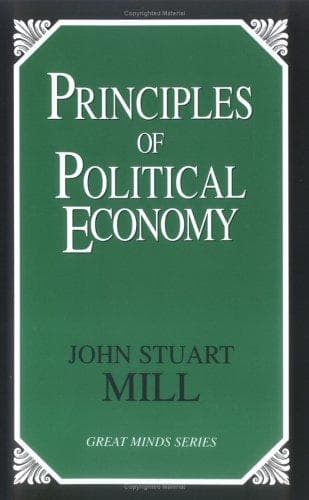
Principles of Political Economy: Abridged with Critical, Bibliographical, and Explanatory Notes, and a Sketch of the History of Political EconomyMill, John Stuart
PhilosophyPhilosophy
Principles of Political Economy: Abridged with Critical, Bibliographical, and Explanatory Notes, and a Sketch of the History of Political Economy
Mill, John Stuart
Economics
The dependence of wages on the number of the competitors for employment is
so far from hard of comprehension, or unintelligible to the
laboring-classes, that by great bodies of them it is already recognized
and habitually acted on. It is familiar to all trades-unions: every
successful combination to keep up wages owes its success to contrivances
for restricting the number of competitors; all skilled trades are anxious
to keep down their own numbers, and many impose, or endeavor to impose, as
a condition upon employers, that they shall not take more than a
prescribed number of apprentices. There is, of course, a great difference
between limiting their numbers by excluding other people, and doing the
same thing by a restraint imposed on themselves; but the one as much as
the other shows a clear perception of the relation between their numbers
and their remuneration. The principle is understood in its application to
any one employment, but not to the general mass of employment. For this
there are several reasons: first, the operation of causes is more easily
and distinctly seen in the more circumscribed field; secondly, skilled
artisans are a more intelligent class than ordinary manual laborers; and
the habit of concert, and of passing in review their general condition as
a trade, keeps up a better understanding of their collective interests;
thirdly and lastly, they are the most provident, because they are the best
off, and have the most to preserve.
§ 5. Twofold means of Elevating the Habits of the Laboring-People; by
Education, and by Foreign and Home Colonization.
For the purpose, therefore, of altering the habits of the laboring people,
there is need of a twofold action, directed simultaneously upon their
intelligence and their poverty. An effective national education of the
children of the laboring-class is the first thing needful; and,
coincidently with this, a system of measures which shall (as the
Revolution did in France) extinguish extreme poverty for one whole
generation. Without entering into disputable points, it may be asserted
without scruple that the aim of all intellectual training for the mass of
the people should be to cultivate common sense; to qualify them for
forming a sound practical judgment of the circumstances by which they are
surrounded. [But] education is not compatible with extreme poverty. It is
impossible effectually to teach an indigent population. Toward effecting
this object there are two resources available, without wrong to any one,
without any of the liabilities of mischief attendant on voluntary or legal
charity, and not only without weakening, but on the contrary
strengthening, every incentive to industry, and every motive to
forethought.
Public-domain text, read in full here on John Shaqi.
Reviews
Reviews
No reviews yet
Be the first to share your thoughts on this work.
Elsewhere in the archive
Join the Discussion
Join the discussion
Sign in to leave a comment or review.
Sign InorCreate an account