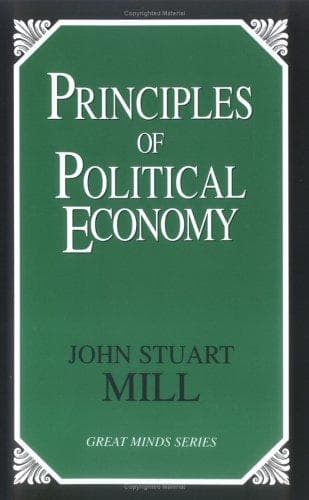
Principles of Political Economy: Abridged with Critical, Bibliographical, and Explanatory Notes, and a Sketch of the History of Political EconomyMill, John Stuart
PhilosophyPhilosophy
Principles of Political Economy: Abridged with Critical, Bibliographical, and Explanatory Notes, and a Sketch of the History of Political Economy
Mill, John Stuart
Economics
The first is a great national measure of colonization. I mean, a grant of
public money, sufficient to remove at once, and establish in the colonies,
a considerable fraction of the youthful agricultural population. It has
been shown by others that colonization on an adequate scale might be so
conducted as to cost the country nothing, or nothing that would not be
certainly repaid; and that the funds required, even by way of advance,
would not be drawn from the capital employed in maintaining labor, but
from that surplus which can not find employment at such profit as
constitutes an adequate remuneration for the abstinence of the possessor,
and which is therefore sent abroad for investment, or wasted at home in
reckless speculations.
The second resource would be to devote all common land, hereafter brought
into cultivation, to raising a class of small proprietors. What I would
propose is, that common land should be divided into sections of five acres
or thereabout, to be conferred in absolute property on individuals of the
laboring-class who would reclaim and bring them into cultivation by their
own labor.
This suggestion works to the same purpose as the proposal that our
Government should retain its public lands and aid in the formation
of a great number of small farmers, rather than, by huge grants,
to foster large holdings in the Western States and
Territories.(174)
The preference should be given to such laborers, and there are many of
them, as had saved enough to maintain them until their first crop was got
in, or whose character was such as to induce some responsible person to
advance to them the requisite amount on their personal security. The
tools, the manure, and in some cases the subsistence also, might be
supplied by the parish, or by the state; interest for the advance, at the
rate yielded by the public funds, being laid on as a perpetual quitrent,
with power to the peasant to redeem it at any time for a moderate number
of years’ purchase. These little landed estates might, if it were thought
necessary, be indivisible by law; though, if the plan worked in the manner
designed, I should not apprehend any objectionable degree of subdivision.
In case of intestacy, and in default of amicable arrangement among the
heirs, they might be bought by government at their value, and re-granted
to some other laborer who could give security for the price. The desire to
possess one of these small properties would probably become, as on the
Continent, an inducement to prudence and economy pervading the whole
laboring population; and that great desideratum among a people of hired
laborers would be provided, an intermediate class between them and their
employers; affording them the double advantage of an object for their
hopes, and, as there would be good reason to anticipate, an example for
their imitation.
Public-domain text, read in full here on John Shaqi.
Reviews
Reviews
No reviews yet
Be the first to share your thoughts on this work.
Elsewhere in the archive
Join the Discussion
Join the discussion
Sign in to leave a comment or review.
Sign InorCreate an account