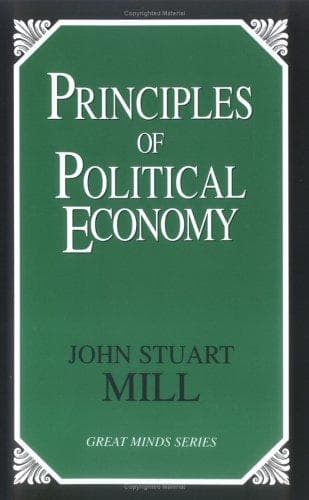
Principles of Political Economy: Abridged with Critical, Bibliographical, and Explanatory Notes, and a Sketch of the History of Political EconomyMill, John Stuart
PhilosophyPhilosophy
Principles of Political Economy: Abridged with Critical, Bibliographical, and Explanatory Notes, and a Sketch of the History of Political Economy
Mill, John Stuart
Economics
As the wages of the laborer are the remuneration of labor, so [a part of]
the profits of the capitalist are properly, according to Mr. Senior’s
well-chosen expression, the remuneration of abstinence. They are what he
gains by forbearing to consume his capital for his own uses, and allowing
it to be consumed by productive laborers for their uses. For this
forbearance he requires a recompense.
Of the gains, however, which the possession of a capital enables a person
to make, (1) a part only is properly an equivalent for the use of the
capital itself; namely, as much as a solvent person would be willing to
pay for the loan of it. This, which as everybody knows is called interest,
is all that a person is enabled to get by merely abstaining from the
immediate consumption of his capital, and allowing it to be used for
productive purposes by others. The remuneration which is obtained in any
country for mere abstinence is measured by the current rate of interest on
the best security; such security as precludes any appreciable chance of
losing the principal. What a person expects to gain, who superintends the
employment of his own capital, is always more, and generally much more,
than this. The rate of profit greatly exceeds the rate of interest. (2.)
The surplus is partly compensation for risk. By lending his capital on
unexceptionable security he runs little or no risk. But if he embarks in
business on his own account, he always exposes his capital to some, and in
many cases to very great, danger of partial or total loss. For this danger
he must be compensated, otherwise he will not incur it. (3.) He must
likewise be remunerated for the devotion of his time and labor. The
control of the operations of industry usually belongs to the person who
supplies the whole or the greatest part of the funds by which they are
carried on, and who, according to the ordinary arrangement, is either
alone interested, or is the person most interested (at least directly), in
the result. To exercise this control with efficiency, if the concern is
large and complicated, requires great assiduity, and often no ordinary
skill. This assiduity and skill must be remunerated.
The gross profits from capital, the gains returned to those who supply the
funds for production, must suffice for these three purposes; and the three
parts into which profit may be considered as resolving itself may be
described respectively as interest, insurance, and wages of
superintendence.
Public-domain text, read in full here on John Shaqi.
Reviews
Reviews
No reviews yet
Be the first to share your thoughts on this work.
Elsewhere in the archive
Join the Discussion
Join the discussion
Sign in to leave a comment or review.
Sign InorCreate an account