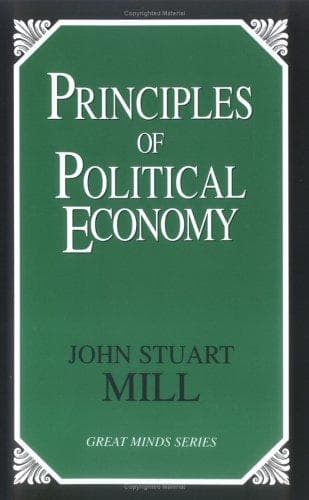
Principles of Political Economy: Abridged with Critical, Bibliographical, and Explanatory Notes, and a Sketch of the History of Political EconomyMill, John Stuart
PhilosophyPhilosophy
Principles of Political Economy: Abridged with Critical, Bibliographical, and Explanatory Notes, and a Sketch of the History of Political Economy
Mill, John Stuart
Economics
Inasmuch as risk is the cause affecting the rate of interest, it
would be much simpler to consider the whole reward for abstinence
as interest, the rate of which is affected by the risk; and to
carefully exclude from the profits of capital the payment for
“assiduity and skill,” which is distinctly wages of labor. The
“wages of superintendence,” as every one on a moment’s reflection
must admit, have no necessary connection whatever with the
possession of capital. The thing with which the laborer is
occupied does not give the reason for associating his wages with
the name of that thing; because a highly-qualified manager
supervises the operations of capital, it does not follow that he
has capital, or should be regarded as being paid for the
possession of capital. The man who shovels ashes is not paid wages
of ashes, any more than a man who superintends other people’s
capital is paid the reward of capital. The payment for services,
in the one case as in the other, depends upon the skill of the
manager, just as it does with an ordinary mechanic, rising or
falling with his fitness for the peculiar work. Skill as a manager
is the cause; the amount of the remuneration is the consequence.
If so, then the wages of superintendence have no logical
connection, in the economic sense, with capital as the thing which
determines the amount of its reward, any more than it affects the
wages of any and all labor. The payment for the use of capital,
simply as capital, may be seen by the amount which a widow who is
not engaged in active business receives from her property invested
as trust funds. Moreover, it is less and less true that the
manager of the operations of industry is necessarily the
capitalist. To see this, mark the executive managers (called
“treasurers” by custom) of cotton and woolen mills, who receive a
remuneration entirely distinct from any capital they may have
invested in the shares of the corporation; and the officials of
the great mutual insurance companies, who receive the wages of
managers, but for managing the capital of others. A large—by far
the largest—part of what is usually called profit, therefore,
should be treated as wages, and the forces which govern its amount
are the same as those affecting the amounts of all other kinds of
wages, such as are discussed in the preceding chapter. The
acknowledgment of this distinction is of extreme importance, and
affects, in a profound way, the whole question of distribution. To
include “wages of superintendence” in profits of capital is to
unnecessarily complicate one of the most serious economic
questions—namely, the relations of capital and labor.
§ 2. The Minimum of Profits; what produces Variations in the Amount of
Profits.
Public-domain text, read in full here on John Shaqi.
Reviews
Reviews
No reviews yet
Be the first to share your thoughts on this work.
Elsewhere in the archive
Join the Discussion
Join the discussion
Sign in to leave a comment or review.
Sign InorCreate an account