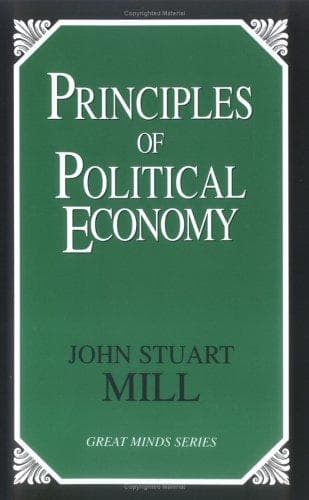
Principles of Political Economy: Abridged with Critical, Bibliographical, and Explanatory Notes, and a Sketch of the History of Political EconomyMill, John Stuart
PhilosophyPhilosophy
Principles of Political Economy: Abridged with Critical, Bibliographical, and Explanatory Notes, and a Sketch of the History of Political Economy
Mill, John Stuart
Economics
The minimum of profits can not properly include wages of
superintendence, nor is it so included, practically, in Mr. Mill’s
discussions on the minimum of profits in a later part of this
volume. The operation of the various elements in changing the
amount of profits might be expressed as follows: As between
different countries and communities, who have a different
effective desire of accumulation, profits may vary with the
element of interest and risk; within the same district, where
interest is generally the same on the same security, profits may
vary with the risk attached to different industries; and, within
the same occupations, interest and risk being given, the wages of
superintendence may make a greater variation than either of the
other two causes—since a skillful manager may make a large return,
a poor one none at all. Or between two employments, interest and
risk remaining the same, wages of superintendence sometimes
produce a wide difference.
The portion, too, of the gross profit, which forms the remuneration for
the labor and skill of the dealer or producer, is very different in
different employments. This is the explanation always given of the
extraordinary rate of apothecaries’ profit. There are cases, again, in
which a considerable amount of labor and skill is required to conduct a
business necessarily of limited extent. In such cases a higher than common
rate of profit is necessary to yield only the common rate of remuneration.
All the natural monopolies (meaning thereby those which are created by
circumstances, and not by law) which produce or aggravate the disparities
in the remuneration of different kinds of labor, operate similarly between
different employments of capital.
In this passage Mr. Mill points out distinctly that the movement
up and down in the wages of a manager are governed by the same
laws as those which regulate differences in the different rewards
of labor, but yet he connects it improperly with capital. It will
be seen that Mr. Mill uses the term “gross profit” on the next
page in order to avoid the difficulty, which rises unconsciously
in his mind, of the anomalous presence of the wages of the manager
in the question of profit.
§ 3. General Tendency of Profits to an Equality.
Public-domain text, read in full here on John Shaqi.
Reviews
Reviews
No reviews yet
Be the first to share your thoughts on this work.
Elsewhere in the archive
Join the Discussion
Join the discussion
Sign in to leave a comment or review.
Sign InorCreate an account