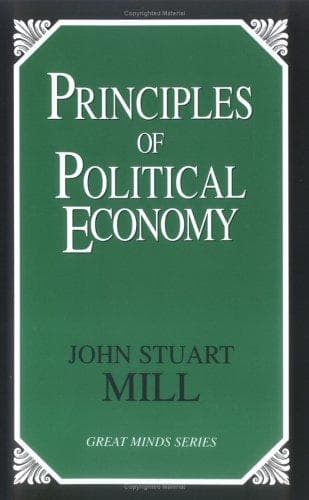
Principles of Political Economy: Abridged with Critical, Bibliographical, and Explanatory Notes, and a Sketch of the History of Political EconomyMill, John Stuart
PhilosophyPhilosophy
Principles of Political Economy: Abridged with Critical, Bibliographical, and Explanatory Notes, and a Sketch of the History of Political Economy
Mill, John Stuart
Economics
The lowest rate of profit that can permanently exist is that which is
barely adequate, at the given place and time, to afford an equivalent for
the abstinence, risk, and exertion implied in the employment of capital.
From the gross profit has first to be deducted as much as will form a fund
sufficient on the average to cover all losses incident to the employment.
Next, it must afford such an equivalent to the owner of the capital for
forbearing to consume it as is then and there a sufficient motive to him
to persist in his abstinence. How much will be required to form this
equivalent depends on the comparative value placed, in the given society,
upon the present and the future (in the words formerly used): on the
strength of the effective desire of accumulation. Further, after covering
all losses, and remunerating the owner for forbearing to consume, there
must be something left to recompense the labor and skill of the person who
devotes his time to the business.
Such, then, is the minimum of profits: but that minimum is exceedingly
variable, and at some times and places extremely low, on account of the
great variableness of two out of its three elements. That the rate of
necessary remuneration for abstinence, or in other words the effective
desire of accumulation, differs widely in different states of society and
civilization, has been seen in a former chapter. There is a still wider
difference in the element which consists in compensation for risk.
The remuneration of capital in different employments, much more than the
remuneration of labor, varies according to the circumstances which render
one employment more attractive or more repulsive than another. The
profits, for example, of retail trade, in proportion to the capital
employed, exceed those of wholesale dealers or manufacturers, for this
reason among others, that there is less consideration attached to the
employment. The greatest, however, of these differences, is that caused by
difference of risk. The profits of a gunpowder-manufacturer must be
considerably greater than the average, to make up for the peculiar risks
to which he and his property are constantly exposed. When, however, as in
the case of marine adventure, the peculiar risks are capable of being, and
commonly are, commuted for a fixed payment, the premium of insurance takes
its regular place among the charges of production, and the compensation
which the owner of the ship or cargo receives for that payment does not
appear in the estimate of his profits, but is included in the replacement
of his capital.
Public-domain text, read in full here on John Shaqi.
Reviews
Reviews
No reviews yet
Be the first to share your thoughts on this work.
Elsewhere in the archive
Join the Discussion
Join the discussion
Sign in to leave a comment or review.
Sign InorCreate an account