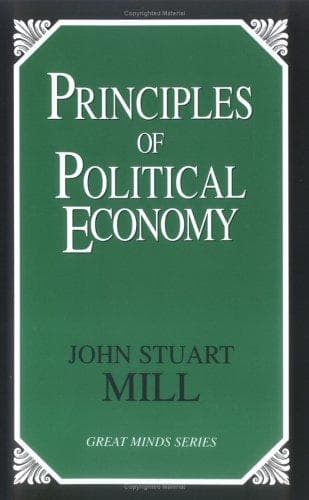
Principles of Political Economy: Abridged with Critical, Bibliographical, and Explanatory Notes, and a Sketch of the History of Political EconomyMill, John Stuart
PhilosophyPhilosophy
Principles of Political Economy: Abridged with Critical, Bibliographical, and Explanatory Notes, and a Sketch of the History of Political Economy
Mill, John Stuart
Economics
(3.) There is a third case, intermediate between the two preceding, and
rather more complex, which I shall at present merely indicate, but the
importance of which in political economy is extremely great. There are
commodities which can be multiplied to an indefinite extent by labor and
expenditure, but not by a fixed amount of labor and expenditure. Only a
limited quantity can be produced at a given cost; if more is wanted, it
must be produced at a greater cost. To this class, as has been often
repeated, agricultural produce belongs, and generally all the rude produce
of the earth; and this peculiarity is a source of very important
consequences; one of which is the necessity of a limit to population; and
another, the payment of rent.
In case (3) articles like agricultural produce have a very great
power to satisfy desires, and if scarce would have a high value.
So far as U is concerned, here also, as in case (2), exchange
value might mount upward to almost any height, but it can go no
higher than D permits. In commodities of this class, affected by
the law of diminishing returns, the tendency is for D to increase,
and so for exchange value to rise, as indicated by the dotted
lines above that of the exchange value.
[Illustration: Same as before.]
§ 3. Commodities limited in Quantity by the law of Demand and Supply:
General working of this Law.
These being the three classes, in one or other of which all things that
are bought and sold must take their place, we shall consider them in their
order. And first, of things absolutely limited in quantity, such as
ancient sculptures or pictures.
Of such things it is commonly said that their value depends on their
scarcity; others say that the value depends on the demand and supply. But
this statement requires much explanation. The supply of a commodity is an
intelligible expression: it means the quantity offered for sale; the
quantity that is to be had, at a given time and place, by those who wish
to purchase it. But what is meant by the demand? Not the mere desire for
the commodity. A beggar may desire a diamond; but his desire, however
great, will have no influence on the price. Writers have therefore given a
more limited sense to demand, and have defined it, the wish to possess,
combined with the power of purchasing.(207) To distinguish demand in this
technical sense from the demand which is synonymous with desire, they call
the former _effectual_ demand.
Public-domain text, read in full here on John Shaqi.
Reviews
Reviews
No reviews yet
Be the first to share your thoughts on this work.
Elsewhere in the archive
Join the Discussion
Join the discussion
Sign in to leave a comment or review.
Sign InorCreate an account