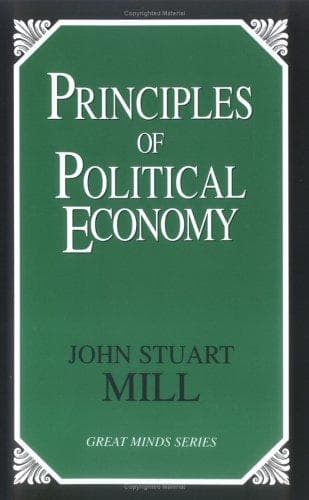
Principles of Political Economy: Abridged with Critical, Bibliographical, and Explanatory Notes, and a Sketch of the History of Political EconomyMill, John Stuart
PhilosophyPhilosophy
Principles of Political Economy: Abridged with Critical, Bibliographical, and Explanatory Notes, and a Sketch of the History of Political Economy
Mill, John Stuart
Economics
General supply consists in the commodities offered in exchange for
other commodities; general demand likewise, if no money exists,
consists in the commodities offered as purchasing power in
exchange for other commodities. That is, one can not increase the
demand for certain things without increasing the supply of some
articles which will be received in exchange for the desired
commodities. Demand is based upon the production of articles
having exchange value, in its economic sense; and the measure of
this demand is necessarily the quantity of commodities offered in
exchange for the desired goods. General demand and supply are thus
reciprocal to each other. But as soon as money, or general
purchasing power, is introduced, Mr. Cairnes(208) defines “demand
as the desire for commodities or services, seeking its end by an
offer of general purchasing power; and supply, as the desire for
general purchasing power, seeking its end by an offer of specific
commodities or services.” But many persons find a difficulty
because they insist upon separating the idea of supply from that
of demand, owing to the fact that producers seem to be a distinct
class in the community, different from consumers. That they are in
reality the same persons can be easily explained by the following
statement: “A certain number of people, A, B, C, D, E, F, etc.,
are engaged in industrial occupations—A produces for B, C, D, E,
F; B for A, C, D, E, F; C for A, B, D, E, F, and so on. In each
case the producer and the consumers are distinct, and hence, by a
very natural fallacy, it is concluded that the whole body of
consumers is distinct from the whole body of producers, whereas
they consist of precisely the same persons.”
But in regard to demand and supply of particular commodities (not
general demand and supply), the increase of the demand is not
necessarily followed by an increased supply, or _vice versa_. Out
of the total production (which constitutes general demand) a
varying amount, sometimes more, sometimes less, may be directed by
the desires of men to the purchase of some given thing. This
should be borne in mind, in connection with the future discussion
of over-production. The identity of general demand with general
supply shows there can be no general over-production: but so long
as there exists the possibility that the demand for a particular
commodity may diminish without a corresponding effect being
thereby produced on the supply of that commodity, by a necessary
connection, we see that there may be over-production of particular
commodities; that is, a production in excess of the demand.
Public-domain text, read in full here on John Shaqi.
Reviews
Reviews
No reviews yet
Be the first to share your thoughts on this work.
Elsewhere in the archive
Join the Discussion
Join the discussion
Sign in to leave a comment or review.
Sign InorCreate an account