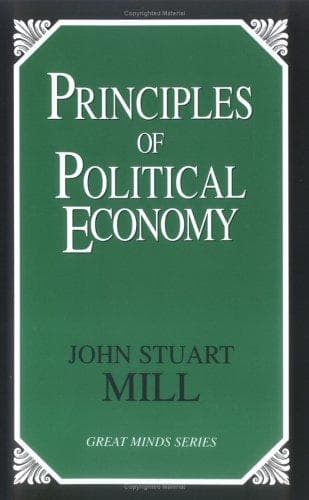
Principles of Political Economy: Abridged with Critical, Bibliographical, and Explanatory Notes, and a Sketch of the History of Political EconomyMill, John Stuart
PhilosophyPhilosophy
Principles of Political Economy: Abridged with Critical, Bibliographical, and Explanatory Notes, and a Sketch of the History of Political Economy
Mill, John Stuart
Economics
Within competing groups, where there is free choice for labor and
capital to select the most remunerative occupations, the hardest
and most disagreeable employments will be best paid, and the wages
and profits will be in proportion to the sacrifice involved in
each case. If so, the amount paid in wages and profits represents
the sacrifices in each case. Now, the aggregate product of an
industry is the source from which is drawn its wages and profits:
the aggregate wages and profits, therefore, must vary with the
value of the total product. If the total value depart from the sum
hitherto sufficient to pay the given wages and profits, then some
will be paid proportionally less than their sacrifice. The value
of a commodity, therefore, within the competing group, must
conform to the costs of production. If, for example (_a_), the
value at any time were such as not to give the laborer the usual
equivalent for his sacrifice, he would change his employment to
another within the group where he could get it; if (_b_) the share
of the capitalist were at any time insufficient to give him the
usual reward for his abstinence, he would change the investment of
his capital. Therefore, within such limits as allow a free
competition of labor and capital, value must conform itself to
cost of production.
Not so, however, with the products of non-competing industrial
groups. As shown by Mr. Mill, labor does not pass freely from one
employment to another; and it must be said that capital does not
either, although vastly more ready to move than labor. In a large
and thinly settled country capital does not move freely over the
whole area of industry; if it did, different rates of profit would
not prevail, as we all know they do, in the United States. Now, as
before stated, the total value of the commodities resulting from
the exertions of each group of producers is the source from which
wages and profits are drawn. The aggregate wages and profits in
each industry will vary with the value of the aggregate products.
But this total value depends upon what it will exchange for of the
products of other groups; that is, this value depends on the
reciprocal demand of one group for the commodities of the other
groups, as compared with the demand of the other groups for its
products. For example, although cost of production is low in group
A, if the demand from outside groups were to be strong, the
exchange value of A’s products would rise, and A would get more of
other goods in exchange; that is, the total produce is large, but
a second increment, arising from a higher exchange value, is to be
shared among A’s laborers and capitalists. A few years ago, about
1878-1879, the value of wheat in the United States rose because of
the increased demand from Europe, where the harvests had been
Public-domain text, read in full here on John Shaqi.
Reviews
Reviews
No reviews yet
Be the first to share your thoughts on this work.
Elsewhere in the archive
Join the Discussion
Join the discussion
Sign in to leave a comment or review.
Sign InorCreate an account