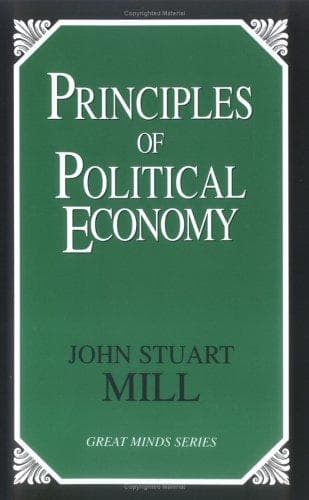
Principles of Political Economy: Abridged with Critical, Bibliographical, and Explanatory Notes, and a Sketch of the History of Political EconomyMill, John Stuart
PhilosophyPhilosophy
Principles of Political Economy: Abridged with Critical, Bibliographical, and Explanatory Notes, and a Sketch of the History of Political Economy
Mill, John Stuart
Economics
unusually deficient. There had been no falling off in the
productiveness of the farming industry of the United States to
cause the increased price; but the relative demand of other
industrial groups for wheat, the product of the farming industry,
raised the exchange value of wheat, and so increased the
industrial rewards of those engaged as laborers and capitalists in
farming. So it is to be concluded that since there is no free
movement of labor and capital between non-competing groups, wages
and profits may constantly remain at rates which are not in
correspondence with the actual sacrifice, or cost, to labor and
capital in different groups; hence, their products do not exchange
for each other in proportion to their costs of production.
Reciprocal demand is the law of their value.
It will be said, at once, that the foregoing conception of cost of
production is entirely opposed to the language of practical men of
affairs. They constantly speak of higher or lower wages as
increasing their cost of production, or as affecting their ability
to compete with foreigners. So universal a usage implies a
foundation of truth which demands attention. Wages do represent
cost to the capitalist, that is, the chief part of the outlay he
makes in order to get a given return; but we have already seen
this, and, in the language of Political Economy, termed it “cost
of labor” to the capitalist. When the business world use the
phrase cost of production, they use it in the sense of cost of
labor, as hitherto explained. When they are obliged by strikers to
pay more wages, they say that it increases their “cost of
production,” meaning the cost to them of getting their product,
and that it affects their profits. This, then, will show that
there is no objection to be urged, in its true sense, against the
phrase cost of production, arising from its misuse in the common
language of business.
Public-domain text, read in full here on John Shaqi.
Reviews
Reviews
No reviews yet
Be the first to share your thoughts on this work.
Elsewhere in the archive
Join the Discussion
Join the discussion
Sign in to leave a comment or review.
Sign InorCreate an account