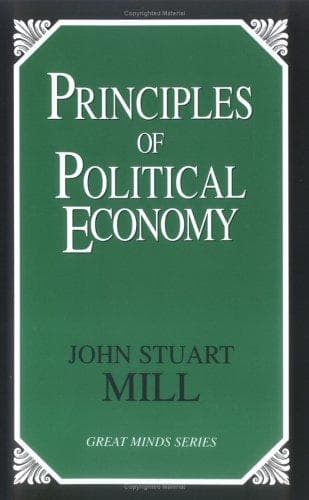
Principles of Political Economy: Abridged with Critical, Bibliographical, and Explanatory Notes, and a Sketch of the History of Political EconomyMill, John Stuart
PhilosophyPhilosophy
Principles of Political Economy: Abridged with Critical, Bibliographical, and Explanatory Notes, and a Sketch of the History of Political Economy
Mill, John Stuart
Economics
By a tacit concurrence, almost all nations, at a very early period, fixed
upon certain metals, and especially gold and silver, to serve this
purpose. No other substances unite the necessary qualities in so great a
degree, with so many subordinate advantages. These were the things which
it most pleased every one to possess, and which there was most certainty
of finding others willing to receive in exchange for any kind of produce.
They were among the most imperishable of all substances. They were also
portable, and, containing great value in small bulk, were easily hid; a
consideration of much importance in an age of insecurity. Jewels are
inferior to gold and silver in the quality of divisibility; and are of
very various qualities, not to be accurately discriminated without great
trouble. Gold and silver are eminently divisible, and, when pure, always
of the same quality; and their purity may be ascertained and certified by
a public authority.
Jevons(226) has more fully stated the requisites for a perfect money as—
1. Value.
2. Portability.
3. Indestructibility.
4. Homogeneity.
5. Divisibility.
6. Stability of value.
7. Cognizability.
Accordingly, though furs have been employed as money in some countries,
cattle in others, in Chinese Tartary cubes of tea closely pressed
together, the shells called cowries on the coast of Western Africa, and in
Abyssinia at this day blocks of rock-salt, gold and silver have been
generally preferred by nations which were able to obtain them, either by
industry, commerce, or conquest. To the qualities which originally
recommended them, another came to be added, the importance of which only
unfolded itself by degrees. Of all commodities, they are among the least
influenced by any of the causes which produce fluctuations of value. No
commodity is quite free from such fluctuations. Gold and silver have
sustained, since the beginning of history, one great permanent alteration
of value, from the discovery of the American mines.
In the present age the opening of new sources of supply, so abundant as
the Ural Mountains, California, and Australia, may be the commencement of
another period of decline, on the limits of which it would be useless at
present to speculate. But, on the whole, no commodities are so little
exposed to causes of variation. They fluctuate less than almost any other
things in their cost of production. And, from their durability, the total
quantity in existence is at all times so great in proportion to the annual
supply, that the effect on value even of a change in the cost of
production is not sudden: a very long time being required to diminish
materially the quantity in existence, and even to increase it very greatly
not being a rapid process. Gold and silver, therefore, are more fit than
any other commodity to be the subject of engagements for receiving or
paying a given quantity at some distant period.
Public-domain text, read in full here on John Shaqi.
Reviews
Reviews
No reviews yet
Be the first to share your thoughts on this work.
Elsewhere in the archive
Join the Discussion
Join the discussion
Sign in to leave a comment or review.
Sign InorCreate an account