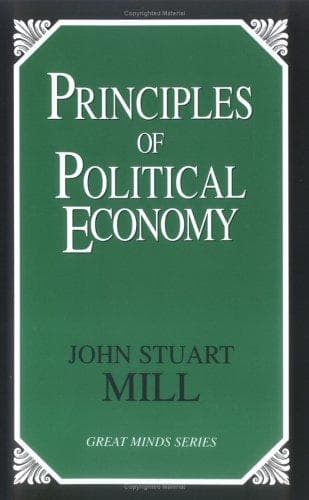
Principles of Political Economy: Abridged with Critical, Bibliographical, and Explanatory Notes, and a Sketch of the History of Political EconomyMill, John Stuart
PhilosophyPhilosophy
Principles of Political Economy: Abridged with Critical, Bibliographical, and Explanatory Notes, and a Sketch of the History of Political Economy
Mill, John Stuart
Economics
Since Mr. Mill wrote, two great changes in the production of the
precious metals have occurred. The discoveries of gold, briefly
referred to by him, have led to an enormous increase of the
existing fund of gold (see chart No. IX, Chap. VI), and a fall in
the value of gold within twenty years after the discoveries,
according to Mr. Jevons’s celebrated study,(227) of from nine to
fifteen per cent. Another change took place, a change in the
value, of silver, in 1876, which has resulted in a permanent fall
of its value since that time (see chart No. X, Chap. VII). Before
that date, silver sold at about 60_d._ per ounce in the central
market of the world, London; and now it remains about 52_d._ per
ounce, although it once fell to 47_d._, in July, 1876. In spite of
Mr. Mill’s expressions of confidence in their stability of
value—although certainly more stable than other commodities—the
events of the last thirty-five years have fully shown that neither
gold nor silver—silver far less than gold—can successfully serve
as a perfect “standard of value” for any considerable length of
time.
When gold and silver had become virtually a medium of exchange, by
becoming the things for which people generally sold, and with which they
generally bought, whatever they had to sell or to buy, the contrivance of
coining obviously suggested itself. By this process the metal was divided
into convenient portions, of any degree of smallness, and bearing a
recognized proportion to one another; and the trouble was saved of
weighing and assaying at every change of possessors—an inconvenience
which, on the occasion of small purchases, would soon have become
insupportable. Governments found it their interest to take the operation
into their own hands, and to interdict all coining by private persons.
§ 3. Money a mere contrivance for facilitating exchanges, which does not
affect the laws of value.
Public-domain text, read in full here on John Shaqi.
Reviews
Reviews
No reviews yet
Be the first to share your thoughts on this work.
Elsewhere in the archive
Join the Discussion
Join the discussion
Sign in to leave a comment or review.
Sign InorCreate an account