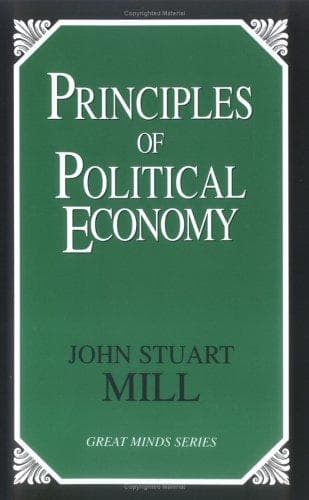
Principles of Political Economy: Abridged with Critical, Bibliographical, and Explanatory Notes, and a Sketch of the History of Political EconomyMill, John Stuart
PhilosophyPhilosophy
Principles of Political Economy: Abridged with Critical, Bibliographical, and Explanatory Notes, and a Sketch of the History of Political Economy
Mill, John Stuart
Economics
It must be evident, however, that the mere introduction of a particular
mode of exchanging things for one another, by first exchanging a thing for
money, and then exchanging the money for something else, makes no
difference in the essential character of transactions. It is not with
money that things are really purchased. Nobody’s income (except that of
the gold or silver miner) is derived from the precious metals. The
[dollars or cents] which a person receives weekly or yearly are not what
constitutes his income; they are a sort of tickets or orders which he can
present for payment at any shop he pleases, and which entitle him to
receive a certain value of any commodity that he makes choice of. The
farmer pays his laborers and his landlord in these tickets, as the most
convenient plan for himself and them; but their real income is their share
of his corn, cattle, and hay, and it makes no essential difference whether
he distributes it to them directly, or sells it for them and gives them
the price. There can not, in short, be intrinsically a more insignificant
thing, in the economy of society, than money; except in the character of a
contrivance for sparing time and labor. It is a machine for doing quickly
and commodiously what would be done, though less quickly and commodiously,
without it; and, like many other kinds of machinery, it only exerts a
distinct and independent influence of its own when it gets out of order.
The introduction of money does not interfere with the operation of any of
the Laws of Value laid down in the preceding chapters. The reasons which
make the temporary or market value of things depend on the demand and
supply, and their average and permanent values upon their cost of
production, are as applicable to a money system as to a system of barter.
Things which by barter would exchange for one another will, if sold for
money, sell for an equal amount of it, and so will exchange for one
another still, though the process of exchanging them will consist of two
operations instead of only one. The relations of commodities to one
another remain unaltered by money; the only new relation introduced is
their relation to money itself; how much or how little money they will
exchange for; in other words, how the Exchange Value of money itself is
determined. Money is a commodity, and its value is determined like that of
other commodities, temporarily by demand and supply, permanently and on
the average by cost of production.
Chapter V. Of The Value Of Money, As Dependent On Demand And Supply.
§ 1. Value of Money, an ambiguous expression.
Public-domain text, read in full here on John Shaqi.
Reviews
Reviews
No reviews yet
Be the first to share your thoughts on this work.
Elsewhere in the archive
Join the Discussion
Join the discussion
Sign in to leave a comment or review.
Sign InorCreate an account