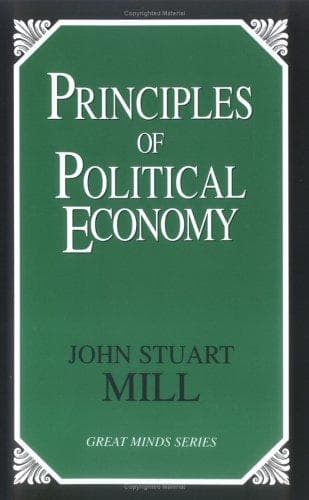
Principles of Political Economy: Abridged with Critical, Bibliographical, and Explanatory Notes, and a Sketch of the History of Political EconomyMill, John Stuart
PhilosophyPhilosophy
Principles of Political Economy: Abridged with Critical, Bibliographical, and Explanatory Notes, and a Sketch of the History of Political Economy
Mill, John Stuart
Economics
We are supposing, of course, that things are left to themselves.
Governments have not always left things to themselves. It was, until
lately, the policy of all governments to interdict the exportation and the
melting of money; while, by encouraging the exportation and impeding the
importation of other things, they endeavored to have a stream of money
constantly flowing in. By this course they gratified two prejudices: they
drew, or thought that they drew, more money into the country, which they
believed to be tantamount to more wealth; and they gave, or thought that
they gave, to all producers and dealers, high prices, which, though no
real advantage, people are always inclined to suppose to be one.
We are, however, to suppose a state, not of artificial regulation, but of
freedom. In that state, and assuming no charge to be made for coinage, the
value of money will conform to the value of the bullion of which it is
made. A pound-weight of gold or silver in coin, and the same weight in an
ingot, will precisely exchange for one another. On the supposition of
freedom, the metal can not be worth more in the state of bullion than of
coin; for as it can be melted without any loss of time, and with hardly
any expense, this would of course be done until the quantity in
circulation was so much diminished as to equalize its value with that of
the same weight in bullion. It may be thought, however, that the coin,
though it can not be of less, may be, and being a manufactured article
will naturally be, of greater value than the bullion contained in it, on
the same principle on which linen cloth is of more value than an equal
weight of linen yarn. This would be true, were it not that Government, in
this country and in some others, coins money gratis for any one who
furnishes the metal. If Government, however, throws the expense of
coinage, as is reasonable, upon the holder, by making a charge to cover
the expense (which is done by giving back rather less in coin than has
been received in bullion, and is called levying a seigniorage), the coin
will rise, to the extent of the seigniorage, above the value of the
bullion. If the mint kept back one per cent, to pay the expense of
coinage, it would be against the interest of the holders of bullion to
have it coined, until the coin was more valuable than the bullion by at
least that fraction. The coin, therefore, would be kept one per cent
higher in value, which could only be by keeping it one per cent less in
quantity, than if its coinage were gratuitous.
Public-domain text, read in full here on John Shaqi.
Reviews
Reviews
No reviews yet
Be the first to share your thoughts on this work.
Elsewhere in the archive
Join the Discussion
Join the discussion
Sign in to leave a comment or review.
Sign InorCreate an account