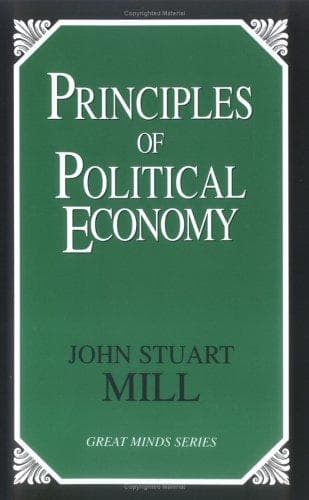
Principles of Political Economy: Abridged with Critical, Bibliographical, and Explanatory Notes, and a Sketch of the History of Political EconomyMill, John Stuart
PhilosophyPhilosophy
Principles of Political Economy: Abridged with Critical, Bibliographical, and Explanatory Notes, and a Sketch of the History of Political Economy
Mill, John Stuart
Economics
In the United States there was no charge for seigniorage on gold
and silver to 1853, when one half of one per cent was charged as
interest on the delay if coin was immediately delivered on the
deposit of bullion; in 1873 it was reduced to one fifth of one per
cent; and in 1875, by a provision of the Resumption Act, it was
wholly abolished (the depositor, however, paying for the copper
alloy). For the trade-dollars, as was consistent with their being
only coined ingots and not legal money, a seigniorage was charged
equal simply to the expense of coinage, which was one and a
quarter per cent at Philadelphia, and one and a half per cent at
San Francisco on the tale value.
§ 2. —Which is determined by the cost of production.
The value of money, then, conforms permanently, and in a state of freedom
almost immediately, to the value of the metal of which it is made; with
the addition, or not, of the expenses of coinage, according as those
expenses are borne by the individual or by the state.
To the majority of civilized countries gold and silver are foreign
products: and the circumstances which govern the values of foreign
products present some questions which we are not yet ready to examine. For
the present, therefore, we must suppose the country which is the subject
of our inquiries to be supplied with gold and silver by its own mines [as
in the case of the United States], reserving for future consideration how
far our conclusions require modification to adapt them to the more usual
case.
Public-domain text, read in full here on John Shaqi.
Reviews
Reviews
No reviews yet
Be the first to share your thoughts on this work.
Elsewhere in the archive
Join the Discussion
Join the discussion
Sign in to leave a comment or review.
Sign InorCreate an account