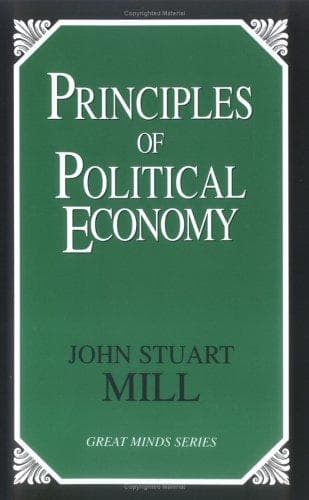
Principles of Political Economy: Abridged with Critical, Bibliographical, and Explanatory Notes, and a Sketch of the History of Political EconomyMill, John Stuart
PhilosophyPhilosophy
Principles of Political Economy: Abridged with Critical, Bibliographical, and Explanatory Notes, and a Sketch of the History of Political Economy
Mill, John Stuart
Economics
From this it will be seen that there has been an enforced coinage
by the Treasury, of almost twice as many silver dollars since 1878
as were coined in all the history of the mint before, since the
establishment of the Government.
It may, perhaps, be asked why the silver dollar of 412-½ grains,
being worth intrinsically only from 86 to 89 cents, does not
depreciate to that value. The Government buys the silver, owns the
coin, and holds all that it can not induce the public to receive
voluntarily; so that but a part of the total coinage is out of the
Treasury. And most of the coins issued are returned for deposit
and silver certificates received in return. There being no free
coinage, and no greater amount in circulation than satisfies the
demand for change, instead of small bills, the dollar-pieces will
circulate at their full value, on the principle of subsidiary
coin, even though overvalued. And the silver certificates
practically go through a process of constant redemption by being
received for customs dues equally with gold. When they become too
great in quantity to be needed for such purposes, then we may look
for the depreciation with good reason.(240)
There are, then, the following kinds of legal tender in the United
States in 1884: (1) Gold coins (if not below tolerance); (2) the
silver dollar of 412-½ grains; (3) United States notes (except for
customs and interest on the public debt); (4) subsidiary silver
coinage, to the amount of five dollars; and (5) minor coins, to
the amount of twenty-five cents.
The question of a double standard has provoked no little vehement
discussion and has called forth a considerable literature since
the fall of silver in 1876. A body of opinion exists, best
represented in this country by F. A. Walker and S. D. Horton, that
the relative values of gold and silver may be kept unchanged, in
spite of all natural causes, by the force of law, which, provided
that enough countries join in the plan, shall fix the ratio of
exchange in the coinage for all great commercial countries, and by
this means keep the coinage ratio equivalent to the bullion ratio.
The difficulty with this scheme, even if it were wholly
sufficient, has thus far been in the obstacles to international
agreement. After several international monetary conferences, in
1867, 1878, and 1881, the project seems now to have been
practically abandoned by all except the most sanguine. (For a
fuller list of authorities on bimetallism, see Appendix I.)
Chapter VIII. Of Credit, As A Substitute For Money.
§ 1. Credit not a creation but a Transfer of the means of Production.
Public-domain text, read in full here on John Shaqi.
Principles of Political Economy: Abridged with Critical, Bibliographical, and Explanatory Notes, and a Sketch of the History of Political Economy — John Shaqi
Reviews
Reviews
No reviews yet
Be the first to share your thoughts on this work.
Elsewhere in the archive
Join the Discussion
Join the discussion
Sign in to leave a comment or review.
Sign InorCreate an account