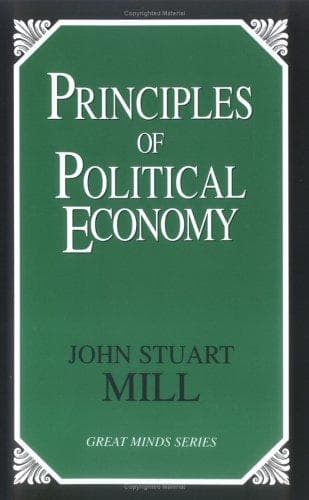
Principles of Political Economy: Abridged with Critical, Bibliographical, and Explanatory Notes, and a Sketch of the History of Political EconomyMill, John Stuart
PhilosophyPhilosophy
Principles of Political Economy: Abridged with Critical, Bibliographical, and Explanatory Notes, and a Sketch of the History of Political Economy
Mill, John Stuart
Economics
Credit has a great, but not, as many people seem to suppose, a magical
power; it can not make something out of nothing. How often is an extension
of credit talked of as equivalent to a creation of capital, or as if
credit actually were capital! It seems strange that there should be any
need to point out that, credit being only permission to use the capital of
another person, the means of production can not be increased by it, but
only transferred. If the borrower’s means of production and of employing
labor are increased by the credit given him, the lender’s are as much
diminished. The same sum can not be used as capital both by the owner and
also by the person to whom it is lent; it can not supply its entire value
in wages, tools, and materials, to two sets of laborers at once. It is
true that the capital which A has borrowed from B, and makes use of in his
business, still forms a part of the wealth of B for other purposes; he can
enter into arrangements in reliance on it, and can borrow, when needful,
an equivalent sum on the security of it; so that to a superficial eye it
might seem as if both B and A had the use of it at once. But the smallest
consideration will show that, when B has parted with his capital to A, the
use of it as capital rests with A alone, and that B has no other service
from it than in so far as his ultimate claim upon it serves him to obtain
the use of another capital from a third person, C.
§ 2. In what manner it assists Production.
But, though credit is never anything more than a transfer of capital from
hand to hand, it is generally, and naturally, a transfer to hands more
competent to employ the capital efficiently in production. If there were
no such thing as credit, or if, from general insecurity and want of
confidence, it were scantily practiced, many persons who possess more or
less of capital, but who from their occupations, or for want of the
necessary skill and knowledge, can not personally superintend its
employment, would derive no benefit from it: their funds would either lie
idle, or would be, perhaps, wasted and annihilated in unskillful attempts
to make them yield a profit. All this capital is now lent at interest, and
made available for production. Capital thus circumstanced forms a large
portion of the productive resources of any commercial country, and is
naturally attracted to those producers or traders who, being in the
greatest business, have the means of employing it to most advantage,
because such are both the most desirous to obtain it and able to give the
best security. Although, therefore, the productive funds of the country
are not increased by credit, they are called into a more complete state of
productive activity. As the confidence on which credit is grounded extends
itself, means are developed by which even the smallest portions of
capital, the sums which each person keeps by him to meet contingencies,
are made available for productive uses. The principal instruments for this
Public-domain text, read in full here on John Shaqi.
Reviews
Reviews
No reviews yet
Be the first to share your thoughts on this work.
Elsewhere in the archive
Join the Discussion
Join the discussion
Sign in to leave a comment or review.
Sign InorCreate an account