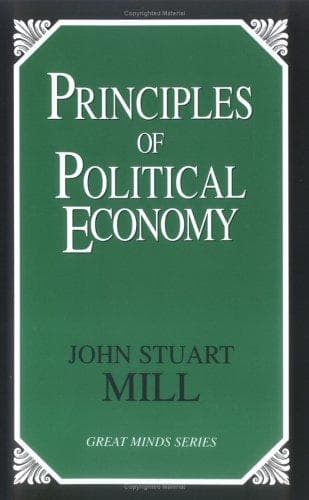
Principles of Political Economy: Abridged with Critical, Bibliographical, and Explanatory Notes, and a Sketch of the History of Political EconomyMill, John Stuart
PhilosophyPhilosophy
Principles of Political Economy: Abridged with Critical, Bibliographical, and Explanatory Notes, and a Sketch of the History of Political Economy
Mill, John Stuart
Economics
But German economists are of interest, inasmuch as they have established a
new school who urge the use of the historical method in political economy,
and it is about the question of method that much of the interest of to-day
centers. In 1814 Savigny introduced this method into jurisprudence, and
about 1850 it was applied to political economy. The new school claim that
the English “orthodox” writers begin by an _a priori_ process, and by
deductions reach conclusions which are possibly true of imaginary cases,
but are not true of man as he really acts. They therefore assert that
economic laws can only be truly discovered by induction, or a study of
phenomena first, as the means of reaching a generalization. To them
Bagehot(80) answers that scientific bookkeeping, or collections of facts,
in themselves give no results ending in scientific laws; for instance,
since the facts of banking change and vary every day, no one can by
induction alone reach any laws of banking; or, for example, the study of a
panic from the concrete phenomena would be like trying to explain the
bursting of a boiler without a theory of steam. More lately,(81) since it
seems that the new school claim that induction does not preclude
deduction, and as the old school never intended to disconnect themselves
from “comparing conclusions with external facts,” there is not such a
cause of difference as has previously appeared. Doubtless the insistence
upon the merits of induction will be fruitful of good to “orthodox”
writers, in the more general resort to the collection of statistics and
means of verification. It is suggestive also that the leaders of the new
school in Germany and England have reached no different results by their
new method, and in the main agree with the laws evolved by the old English
school. The economist does not pretend that his assumptions are
descriptions of economic conditions existing at a given time; he simply
considers them as forces (often acting many on one point or occasion) to
be inquired into separately, inasmuch as concrete phenomena are the
resultants of several forces, not to be known until we know the separate
operation of each of the conjoined forces.
Public-domain text, read in full here on John Shaqi.
Reviews
Reviews
No reviews yet
Be the first to share your thoughts on this work.
Join the Discussion
Join the discussion
Sign in to leave a comment or review.
Sign InorCreate an account