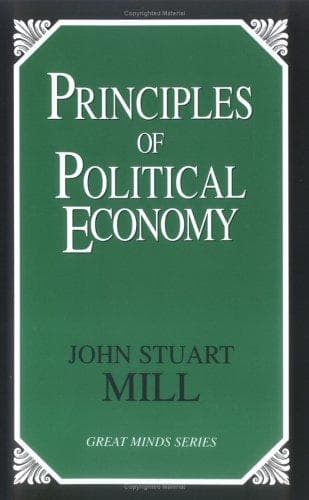
Principles of Political Economy: Abridged with Critical, Bibliographical, and Explanatory Notes, and a Sketch of the History of Political EconomyMill, John Stuart
PhilosophyPhilosophy
Principles of Political Economy: Abridged with Critical, Bibliographical, and Explanatory Notes, and a Sketch of the History of Political Economy
Mill, John Stuart
Economics
Bills of exchange are drawn between the various cities of the
United States. In the West, the factor who is purchasing grain or
wool for a New York firm draws on his New York correspondents, and
this bill (usually certified to by the bill of lading) is
presented for discount at the Western banks; and, if there are
many bills, funds are possibly sent westward to meet these
demands. But the purchases of the West in New York will serve,
even if a little later in time, somewhat to offset this drain; and
the funds will again move eastward, as goods move westward,
practically bartered against each other by the use of bills. There
is, however, less movement of funds of late, now that Western
cities have accumulated more capital of their own.
The notes given in consequence of a real sale of goods can not be
considered as on that account _certainly_ representing any actual
property. Suppose that A sells £100 worth of goods to B at six months’
credit, and takes a bill at six months for it; and that B, within a month
after, sells the same goods, at a like credit, to C, taking a like bill;
and again, that C, after another month, sells them to D, taking a like
bill, and so on. There may then, at the end of six months, be six bills of
£100 each existing at the same time, and every one of these may possibly
have been discounted. Of all these bills, then, only one represents any
actual property.
The extent of a man’s actual sales forms some limit to the amount of his
real notes; and, as it is highly desirable in commerce that credit should
be dealt out to all persons in some sort of regular and due proportion,
the measure of a man’s actual sales, certified by the appearance of his
bills drawn in virtue of those sales, is some rule in the case, though a
very imperfect one in many respects. When a bill drawn upon one person is
paid to another (or even to the same person) in discharge of a debt or a
pecuniary claim, it does something for which, if the bill did not exist,
money would be required: it performs the functions of currency. This is a
use to which bills of exchange are often applied.
Many bills, both domestic and foreign, are at last presented for payment
quite covered with indorsements, each of which represents either a fresh
discounting, or a pecuniary transaction in which the bill has performed
the functions of money.
§ 5. Promissory Notes.
A third form in which credit is employed as a substitute for currency is
that of promissory notes.
The difference between a bill of exchange and a promissory note
is, that the former is an order for the payment of money, while
the latter is a promise to pay money. In a note the promissor is
primarily liable; in a bill the drawer becomes liable only after
an ineffectual resort to the drawee.
Public-domain text, read in full here on John Shaqi.
Reviews
Reviews
No reviews yet
Be the first to share your thoughts on this work.
Elsewhere in the archive
Join the Discussion
Join the discussion
Sign in to leave a comment or review.
Sign InorCreate an account