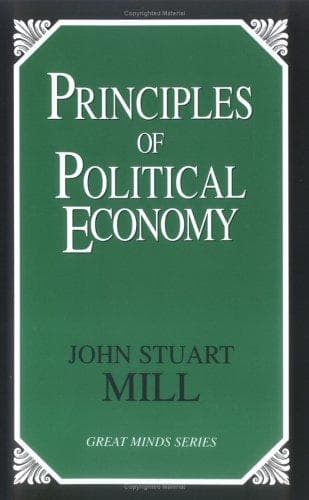
Principles of Political Economy: Abridged with Critical, Bibliographical, and Explanatory Notes, and a Sketch of the History of Political EconomyMill, John Stuart
PhilosophyPhilosophy
Principles of Political Economy: Abridged with Critical, Bibliographical, and Explanatory Notes, and a Sketch of the History of Political Economy
Mill, John Stuart
Economics
In the United States a Western merchant who buys $1,000 worth of
cotton goods, for instance, of a Boston commission-house on
credit, customarily gives his note for the amount, and this note
is put upon the market, or presented at a bank for discount. This
plan, however, puts all risk upon the one who discounted the note.
In the United States such promissory notes are the forms of credit
most used between merchants and buyers. The custom, however, is
quite different in England and Germany (and generally, it is
stated, on the Continent), where bills of exchange are employed in
cases where we use a promissory note. A house in London sells
$1,000 worth of cotton goods to A, in Carlisle, on a credit of
sixty days, draws a bill of exchange on A, which is a demand upon
A to pay in a given time (e.g., sixty days), and if “accepted” by
him is a legal obligation. The London house takes this bill
(perhaps adding its own firm name as indorsers to the paper), and
presents it for discount at a London bank. This now explains why
it is that, when a particular industry is prosperous and many
goods are sold, there is more “paper” offered for discount at the
banks (cf. p. 222), and why capital flows readily in that
direction.
It is chiefly in the latter form [promissory notes] that it has become, in
commercial countries, an express occupation to issue such substitutes for
money. Dealers in money wish to lend, not their capital merely, but their
credit, and not only such portion of their credit as consists of funds
actually deposited with them, but their power of obtaining credit from the
public generally, so far as they think they can safely employ it. This is
done in a very convenient manner by lending their own promissory notes
payable to bearer on demand—the borrower being willing to accept these as
so much money, because the credit of the lender makes other people
willingly receive them on the same footing, in purchases or other
payments. These notes, therefore, perform all the functions of currency,
and render an equivalent amount of money, which was previously in
circulation, unnecessary. As, however, being payable on demand, they may
be at any time returned on the issuer, and money demanded for them, he
must, on pain of bankruptcy, keep by him as much money as will enable him
to meet any claims of that sort which can be expected to occur within the
time necessary for providing himself with more; and prudence also requires
that he should not attempt to issue notes beyond the amount which
experience shows can remain in circulation without being presented for
payment.
Public-domain text, read in full here on John Shaqi.
Reviews
Reviews
No reviews yet
Be the first to share your thoughts on this work.
Elsewhere in the archive
Join the Discussion
Join the discussion
Sign in to leave a comment or review.
Sign InorCreate an account