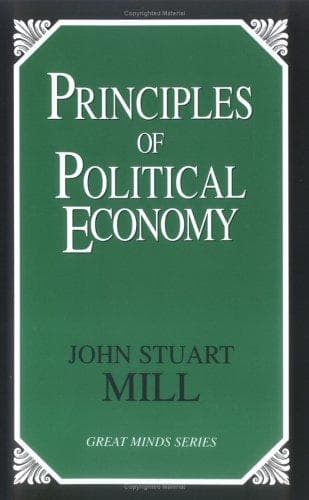
Principles of Political Economy: Abridged with Critical, Bibliographical, and Explanatory Notes, and a Sketch of the History of Political EconomyMill, John Stuart
PhilosophyPhilosophy
Principles of Political Economy: Abridged with Critical, Bibliographical, and Explanatory Notes, and a Sketch of the History of Political Economy
Mill, John Stuart
Economics
Suppose that, in the expectation that some commodity will rise in price,
he determines not only to invest in it all his ready money, but to take up
on credit, from the producers or importers, as much of it as their opinion
of his resources will enable him to obtain. Every one must see that by
thus acting he produces a greater effect on price than if he limited his
purchases to the money he has actually in hand. He creates a demand for
the article to the full amount of his money and credit taken together, and
raises the price proportionally to both. And this effect is produced,
though none of the written instruments called substitutes for currency may
be called into existence; though the transaction may give rise to no bill
of exchange, nor to the issue of a single bank-note. The buyer, instead of
taking a mere book-credit, might have given a bill for the amount, or
might have paid for the goods with bank-notes borrowed for that purpose
from a banker, thus making the purchase not on his own credit with the
seller, but on the banker’s credit with the seller, and his own with the
banker. Had he done so, he would have produced as great an effect on price
as by a simple purchase to the same amount on a book-credit, but no
greater effect. The credit itself, not the form and mode in which it is
given, is the operating cause.
§ 3. Great extensions and contractions of Credit. Phenomena of a
commercial crisis analyzed.
The inclination of the mercantile public to increase their demand for
commodities by making use of all or much of their credit as a purchasing
power depends on their expectation of profit. When there is a general
impression that the price of some commodity is likely to rise from an
extra demand, a short crop, obstructions to importation, or any other
cause, there is a disposition among dealers to increase their stocks in
order to profit by the expected rise. This disposition tends in itself to
produce the effect which it looks forward to—a rise of price; and, if the
rise is considerable and progressive, other speculators are attracted,
who, so long as the price has not begun to fall, are willing to believe
that it will continue rising. These, by further purchases, produce a
further advance, and thus a rise of price, for which there were originally
some rational grounds, is often heightened by merely speculative
purchases, until it greatly exceeds what the original grounds will
justify. After a time this begins to be perceived, the price ceases to
rise, and the holders, thinking it time to realize their gains, are
anxious to sell. Then the price begins to decline, the holders rush into
the market to avoid a still greater loss, and, few being willing to buy in
a falling market, the price falls much more suddenly than it rose. Those
who have bought at a higher price than reasonable calculation justified,
and who have been overtaken by the revulsion before they had realized, are
Public-domain text, read in full here on John Shaqi.
Reviews
Reviews
No reviews yet
Be the first to share your thoughts on this work.
Elsewhere in the archive
Join the Discussion
Join the discussion
Sign in to leave a comment or review.
Sign InorCreate an account