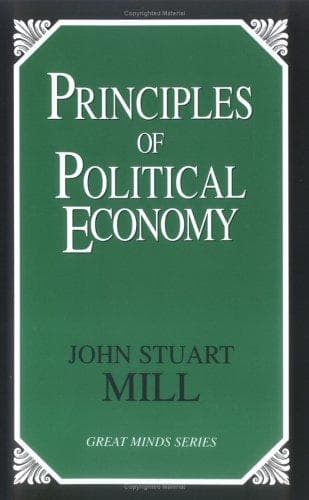
Principles of Political Economy: Abridged with Critical, Bibliographical, and Explanatory Notes, and a Sketch of the History of Political EconomyMill, John Stuart
PhilosophyPhilosophy
Principles of Political Economy: Abridged with Critical, Bibliographical, and Explanatory Notes, and a Sketch of the History of Political Economy
Mill, John Stuart
Economics
losers in proportion to the greatness of the fall and to the quantity of
the commodity which they hold, or have bound themselves to pay for.
This is the ideal extreme case of what is called a commercial crisis.
There is said to be a commercial crisis when a great number of merchants
and traders at once either have, or apprehend that they shall have, a
difficulty in meeting their engagements. The most usual cause of this
general embarrassment is the recoil of prices after they have been raised
by a spirit of speculation, intense in degree, and extending to many
commodities. When, after such a rise, the reaction comes and prices begin
to fall, though at first perhaps only through the desire of the holders to
realize, speculative purchases cease; but, were this all, prices would
only fall to the level from which they rose, or to that which is justified
by the state of the consumption and of the supply. They fall, however,
much lower; for as, when prices were rising, and everybody apparently
making a fortune, it was easy to obtain almost any amount of credit, so
now, when everybody seems to be losing, and many fail entirely, it is with
difficulty that firms of known solidity can obtain even the credit to
which they are accustomed, and which it is the greatest inconvenience to
them to be without, because all dealers have engagements to fulfill, and,
nobody feeling sure that the portion of his means which he has intrusted
to others will be available in time, no one likes to part with ready
money, or to postpone his claim to it. To these rational considerations
there is superadded, in extreme cases, a panic as unreasoning as the
previous over-confidence; money is borrowed for short periods at almost
any rate of interest, and sales of goods for immediate payment are made at
almost any sacrifice. Thus general prices, during a commercial revulsion,
fall as much below the usual level as during the previous period of
speculation they have risen above it; the fall, as well as the rise,
originating not in anything affecting money, but in the state of credit.
Professor Jevons seriously advanced a theory that, inasmuch as the
harvests of the world were the causes of good or bad trade, and
that their deficiency would regularly be followed by commercial
distress, then a periodic cause of bad harvests, if found, would
explain the constant recurrence of commercial crises. This cause
he claimed to have found in the sun-spots, which periodically
deprive the crops of that source of growth which is usually
furnished by the sun when no spots appear.(243) It has not
received general acceptance.
Public-domain text, read in full here on John Shaqi.
Reviews
Reviews
No reviews yet
Be the first to share your thoughts on this work.
Elsewhere in the archive
Join the Discussion
Join the discussion
Sign in to leave a comment or review.
Sign InorCreate an account