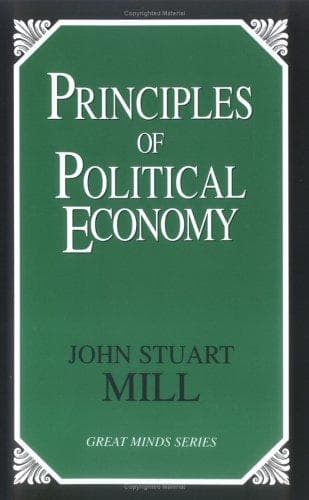
Principles of Political Economy: Abridged with Critical, Bibliographical, and Explanatory Notes, and a Sketch of the History of Political EconomyMill, John Stuart
PhilosophyPhilosophy
Principles of Political Economy: Abridged with Critical, Bibliographical, and Explanatory Notes, and a Sketch of the History of Political Economy
Mill, John Stuart
Economics
In the United States financial disasters have occurred in 1814,
1819, 1825, 1837-1839, 1857, and 1873. Those of 1837 and 1873 seem
to have been the most serious in their effects; but this field, so
far as scientific study is concerned, has not been fully worked,
and much remains to be learned about these crises in the United
States. The crisis of 1873 was due to excessive railway-building.
It was testified(244) concerning the New York banks in 1873 that
“their capital needed for legitimate purposes was practically lent
out on certain iron rails, railroad-ties, bridges, and
rolling-stock, _called_ railroads, many of them laid down in
places where these materials were practically useless.”
Under the effects due to swift communication by steam, but
especially to the electric telegraph, modern credit is a very
different thing from what it was fifty years ago. Now, a shock on
the Bourse at Vienna is felt the same day at Paris, London, and
New York. A commercial crisis in one great money-center is felt at
every other point in the world which has business connections with
it. Moreover, as Cherbuliez(245) says: “A country is more subject
to crises the more advanced is its economical development. There
are certain maladies which attack only grown-up persons who have
reached a certain degree of vigor and maturity.”
§ 4. Influence of the different forms of Credit on Prices.
It does not, indeed, follow that credit _will_ be more used because it
_can_ be. When the state of trade holds out no particular temptation to
make large purchases on credit, dealers will use only a small portion of
the credit-power, and it will depend only on convenience whether the
portion which they use will be taken in one form or in another. One single
exertion of the credit-power in the form of (1) book-credit, is only the
foundation of a single purchase; but, if (2) a bill is drawn, that same
portion of credit may serve for as many purchases as the number of times
the bill changes hands; while (3) every bank-note issued renders the
credit of the banker a purchasing power to that amount in the hands of all
the successive holders, without impairing any power they may possess of
effecting purchases on their own credit. Credit, in short, has exactly the
same purchasing power with money; and as money tells upon prices not
simply in proportion to its amount, but to its amount multiplied by the
number of times it changes hands, so also does credit; and credit
transferable from hand to hand is in that proportion more potent than
credit which only performs one purchase.
Public-domain text, read in full here on John Shaqi.
Reviews
Reviews
No reviews yet
Be the first to share your thoughts on this work.
Elsewhere in the archive
Join the Discussion
Join the discussion
Sign in to leave a comment or review.
Sign InorCreate an account