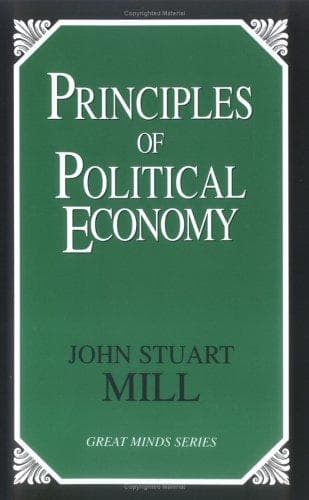
Principles of Political Economy: Abridged with Critical, Bibliographical, and Explanatory Notes, and a Sketch of the History of Political EconomyMill, John Stuart
PhilosophyPhilosophy
Principles of Political Economy: Abridged with Critical, Bibliographical, and Explanatory Notes, and a Sketch of the History of Political Economy
Mill, John Stuart
Economics
REPORTS AND STATISTICS.
The “Compendiums of the Census” for 1840, 1850, 1860, and 1870, are
desirable. The volumes of the tenth census (1880) are of great value for
all questions; as is also F. A. Walker’s “Statistical Atlas” (1874).
The United States Bureau of Statistics issues quarterly statements; and
annually a report on “Commerce and Navigation,” and another on the
“Internal Commerce of the United States.”
The “Statistical Abstract” is an annual publication, by the same
department, compact and useful. It dates only from 1878.
The Director of the Mint issues an annual report dealing with the precious
metals and the circulation. Its tables are important.
The Comptroller of the Currency (especially during the administration of
J. J. Knox) has given important annual reports upon the banking systems of
the United States.
The reports of the Secretary of the Treasury deal with the general
finances of the United States. These, with the two last mentioned, are
bound together in the volume of “Finance Reports,” but often shorn of
their tables.
There are valuable special reports to Congress of commissioners on the
tariff, shipping, and other subjects, published by the Government.
The report on the “International Monetary Conference of 1878” contains a
vast quantity of material on monetary questions.
The British parliamentary documents contain several annual “Statistical
Abstracts” of the greatest value, of which the one relating to other
European states is peculiarly convenient and useful. These can always be
purchased at given prices.
A. R. Spofford’s “American Almanac” is an annual of great usefulness.
Preliminary Remarks.
Writers on Political Economy profess to teach, or to investigate, the
nature of Wealth, and the laws of its production and distribution;
including, directly or remotely, the operation of all the causes by which
the condition of mankind, or of any society of human beings, in respect to
this universal object of human desire, is made prosperous or the reverse.
Public-domain text, read in full here on John Shaqi.
Reviews
Reviews
No reviews yet
Be the first to share your thoughts on this work.
Join the Discussion
Join the discussion
Sign in to leave a comment or review.
Sign InorCreate an account