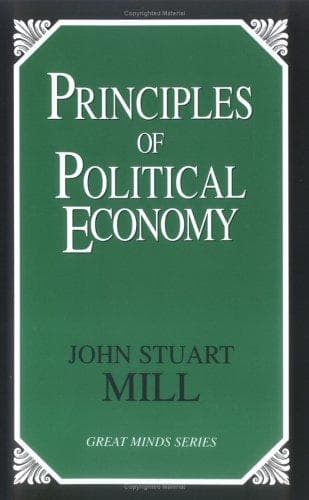
Principles of Political Economy: Abridged with Critical, Bibliographical, and Explanatory Notes, and a Sketch of the History of Political EconomyMill, John Stuart
PhilosophyPhilosophy
Principles of Political Economy: Abridged with Critical, Bibliographical, and Explanatory Notes, and a Sketch of the History of Political Economy
Mill, John Stuart
Economics
The experience of the United States during the civil war is an
illustration of this principle. It is asserted that, as a matter
of fact, the total expenses of the war were defrayed by the
Northern States, during the four years of its continuance, out of
surplus earnings; and yet at the close of the conflict a debt of
$2,800,000,000 was saddled on the country.
The United States borrowed $2,400,000,000
Revenue during that time 1,700,000,000
Total cost of the war $4,100,000,000
In reality we borrowed only about $1,500,000,000 instead of
$2,400,000,000, since (1) the Government issued paper which
depreciated, and yet received it at par in subscriptions for
loans. Moreover, the total cost would have been much reduced had
we issued no paper and (2) thereby not increased the prices of
goods to the state, and (3) if no interest account had been
created by borrowing. But could the country have raised the whole
sum each year by taxation? In the first fiscal year after the war
the United States paid in war taxes $650,000,000. At the beginning
of the struggle, to June 30, 1862, the expenditure was
$515,000,000, and by June 30, 1863, it had amounted to
$1,098,000,000; so that $600,000,000 of taxes a year would have
paid the war expenses, and left us free of debt at the close.
A confirmatory experience is that of England during the
Continental wars, 1793-1817:
Total war expenditures £1,060,000,000
Interest charge on the existing debt 235,000,000
Total amount required £1,295,000,000
Revenue for that period 1,145,000,000
Deficit £150,000,000
To provide for this deficit, the Government actually increased its
debt by £600,000,000. A slight additional exertion would have
provided £150,000,000 more of revenue, and saved £450,000,000 to
the taxpayers.(109)
The practical state of the case, however, seldom exactly corresponds with
this supposition. The loans of the less wealthy countries are made chiefly
with foreign capital, which would not, perhaps, have been brought in to be
invested on any less security than that of the Government: while those of
rich and prosperous countries are generally made, not with funds withdrawn
from productive employment, but with the new accumulations constantly
making from income, and often with a part of them which, if not so taken,
would have migrated to colonies, or sought other investments abroad.
§ 6. Demand for Commodities is not Demand for Labor.
Public-domain text, read in full here on John Shaqi.
Reviews
Reviews
No reviews yet
Be the first to share your thoughts on this work.
Elsewhere in the archive
Join the Discussion
Join the discussion
Sign in to leave a comment or review.
Sign InorCreate an account