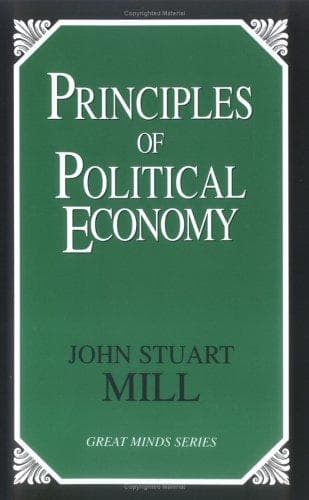
Principles of Political Economy: Abridged with Critical, Bibliographical, and Explanatory Notes, and a Sketch of the History of Political EconomyMill, John Stuart
PhilosophyPhilosophy
Principles of Political Economy: Abridged with Critical, Bibliographical, and Explanatory Notes, and a Sketch of the History of Political Economy
Mill, John Stuart
Economics
§ 2.—through small holdings, by which the landlord’s gain is shared.
§ 3. —through co-operation, by which the manager’s wages are shared.
§ 4. Distributive Co-operation.
§ 5. Productive Co-Operation.
§ 6. Industrial Partnership.
§ 7. People’s Banks.
Book V. On The Influence Of Government.
Chapter I. On The General Principles Of Taxation.
§ 1. Four fundamental rules of Taxation.
§ 2. Grounds of the principle of Equality of Taxation.
§ 3. Should the same percentage be levied on all amounts of Income?
§ 4. Should the same percentage be levied on Perpetual and on
Terminable Incomes?
§ 5. The increase of the rent of land from natural causes a fit
subject of peculiar Taxation.
§ 6. Taxes falling on Capital not necessarily objectionable.
Chapter II. Of Direct Taxes.
§ 1. Direct taxes either on income or expenditure.
§ 2. Taxes on rent.
§ 3. —on profits.
§ 4. —on Wages.
§ 5. —on Income.
§ 6. A House-Tax.
Chapter III. Of Taxes On Commodities, Or Indirect Taxes.
§ 1. A Tax on all commodities would fall on Profits.
§ 2. Taxes on particular commodities fall on the consumer.
§ 3. Peculiar effects of taxes on Necessaries.
§ 4. —how modified by the tendency of profits to a minimum.
§ 5. Effects of discriminating Duties.
§ 6. Effects produced on international Exchange by Duties on Exports
and on Imports.
Chapter IV. Comparison Between Direct And Indirect Taxation.
§ 1. Arguments for and against direct Taxation.
§ 2. What forms of indirect taxation are most eligible?
§ 3. Practical rules for indirect taxation.
§ 4. Taxation systems of the United States and other Countries.
§ 5. A _Résumé_ of the general principles of taxation.
Chapter V. Of A National Debt.
§ 1. Is it desirable to defray extraordinary public expenses by
loans?
§ 2. Not desirable to redeem a national Debt by a general
Contribution.
§ 3. In what cases desirable to maintain a surplus revenue for the
redemption of Debt.
Chapter VI. Of An Interference Of Government Grounded On Erroneous
Theories.
§ 1. The doctrine of Protection to Native Industry.
§ 2. —had its origin in the Mercantile System.
§ 3. —supported by pleas of national subsistence and national
defense.
§ 4. —on the ground of encouraging young industries; colonial
policy.
§ 5. —on the ground of high wages.
§ 6. —on the ground of creating a diversity of industries.
§ 7. —on the ground that it lowers prices.
Appendix I. Bibliographies.
Appendix II. Examination Questions.
Footnotes
PREFACE.
Public-domain text, read in full here on John Shaqi.
Reviews
Reviews
No reviews yet
Be the first to share your thoughts on this work.
Join the Discussion
Join the discussion
Sign in to leave a comment or review.
Sign InorCreate an account