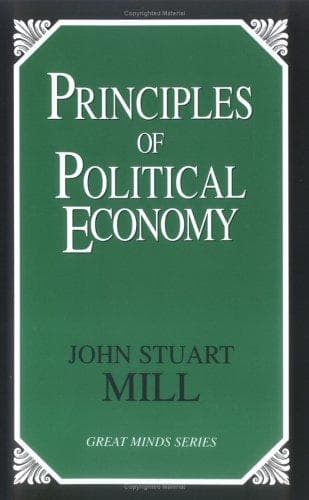
Principles of Political Economy: Abridged with Critical, Bibliographical, and Explanatory Notes, and a Sketch of the History of Political EconomyMill, John Stuart
PhilosophyPhilosophy
Principles of Political Economy: Abridged with Critical, Bibliographical, and Explanatory Notes, and a Sketch of the History of Political Economy
Mill, John Stuart
Economics
The division of labor, as all writers on the subject have remarked, is
limited by the extent of the market. If, by the separation of pin-making
into ten distinct employments, forty-eight thousand pins can be made in a
day, this separation will only be advisable if the number of accessible
consumers is such as to require, every day, something like forty-eight
thousand pins. If there is only a demand for twenty-four thousand, the
division of labor can only be advantageously carried to the extent which
will every day produce that smaller number. The increase of the general
riches of the world, when accompanied with freedom of commercial
intercourse, improvements in navigation, and inland communication by
roads, canals, or railways, tends to give increased productiveness to the
labor of every nation in particular, by enabling each locality to supply
with its special products so much larger a market that a great extension
of the division of labor in their production is an ordinary consequence.
The division of labor is also limited, in many cases, by the nature of the
employment. Agriculture, for example, is not susceptible of so great a
division of occupations as many branches of manufactures, because its
different operations can not possibly be simultaneous.
(5.) “In the examples given above the advantage obtained was
derived from the mere fact of the separation of employments,
altogether independently of the mode in which the separated
employments were distributed among the _persons_ carrying them on,
as well as of the _places_ in which they were conducted. But a
further gain arises when the employments are of a kind which, in
order to their effective performance, call for special capacities
in the workman, or special natural resources in the scene of
operation. There would be a manifest waste of special power in
compelling to a mere mechanical or routine pursuit a man who is
fitted to excel in a professional career; and similarly, if a
branch of industry were established on some site which offered
greater facilities to an industry of another sort, a waste,
analogous in character, would be incurred. In a word, while a
great number of the occupations in which men engage are such as,
with proper preparation for them, might equally well be carried on
by any of those engaged in them, or in any of the localities in
which they are respectively established, there are others which
demand for their effective performance special personal
qualifications and special local conditions; and the general
effectiveness of productive industry will, other things being
equal, be proportioned to the completeness with which the
adaptation is accomplished between occupation on the one hand and
individuals and localities on the other.”(118)
§ 4. Production on a Large and Production on a Small Scale.
Public-domain text, read in full here on John Shaqi.
Reviews
Reviews
No reviews yet
Be the first to share your thoughts on this work.
Elsewhere in the archive
Join the Discussion
Join the discussion
Sign in to leave a comment or review.
Sign InorCreate an account