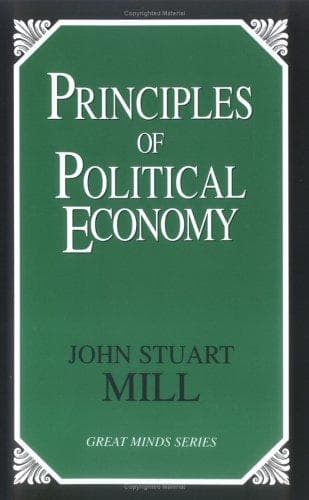
Principles of Political Economy: Abridged with Critical, Bibliographical, and Explanatory Notes, and a Sketch of the History of Political EconomyMill, John Stuart
PhilosophyPhilosophy
Principles of Political Economy: Abridged with Critical, Bibliographical, and Explanatory Notes, and a Sketch of the History of Political Economy
Mill, John Stuart
Economics
Whenever it is essential to the greatest efficiency of labor that many
laborers should combine, the scale of the enterprise must be such as to
bring many laborers together, and the capital must be large enough to
maintain them. Still more needful is this when the nature of the
employment allows, and the extent of the possible market encourages, a
considerable division of labor. The larger the enterprise the further the
division of labor may be carried. This is one of the principal causes of
large manufactories. Every increase of business would enable the whole to
be carried on with a proportionally smaller amount of labor.
As a general rule, the expenses of a business do not increase by any means
proportionally to the quantity of business. Let us take as an example a
set of operations which we are accustomed to see carried on by one great
establishment, that of the Post-Office. Suppose that the business, let us
say only of the letter-post, instead of being centralized in a single
concern, were divided among five or six competing companies. Each of these
would be obliged to maintain almost as large an establishment as is now
sufficient for the whole. Since each must arrange for receiving and
delivering letters in all parts of the town, each must send
letter-carriers into every street, and almost every alley, and this, too,
as many times in the day as is now done by the Post-Office, if the service
is to be as well performed. Each must have an office for receiving letters
in every neighborhood, with all subsidiary arrangements for collecting the
letters from the different offices and redistributing them. To this must
be added the much greater number of superior officers who would be
required to check and control the subordinates, implying not only a
greater cost in salaries for such responsible officers, but the necessity,
perhaps, of being satisfied in many instances with an inferior standard of
qualification, and so failing in the object.
Public-domain text, read in full here on John Shaqi.
Reviews
Reviews
No reviews yet
Be the first to share your thoughts on this work.
Elsewhere in the archive
Join the Discussion
Join the discussion
Sign in to leave a comment or review.
Sign InorCreate an account