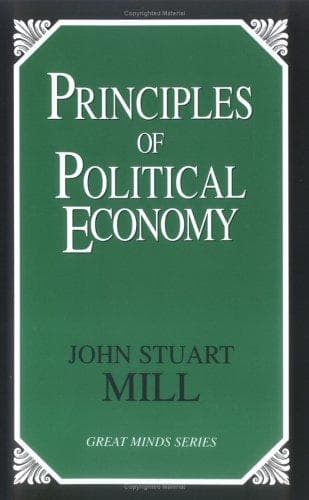
Principles of Political Economy: Abridged with Critical, Bibliographical, and Explanatory Notes, and a Sketch of the History of Political EconomyMill, John Stuart
PhilosophyPhilosophy
Principles of Political Economy: Abridged with Critical, Bibliographical, and Explanatory Notes, and a Sketch of the History of Political Economy
Mill, John Stuart
Economics
Chart IV: Westward Movement of Center of Population.
This, in effect, is the well-known Malthusian doctrine. The
thorough reader will also consult the original “Essay” of Malthus.
Mr. Bowen(119) and other writers oppose it, saying it has “no
relation to the times in which we live, or to any which are near
at hand.” He thinks the productive power of the whole world
prevents the necessity of considering the pressure of population
upon subsistence as an actuality now or in the future. This,
however, does not deny the existence of Malthus’s principles, but
opposes them only on the methods of their action. Mr.
Rickards(120) holds that man’s food—as, e.g., wheat—has the power
to increase geometrically faster than man; but he omits to
consider that for the growth of this food land is demanded; that
land is not capable of such geometrical increase; and that without
it the food can not be grown. Of course, any extension of the land
area, as happened when England abolished the corn laws and drew
her food from our prairies, removes the previous pressure of
population on subsistence. No believer in the Malthusian doctrine
is so absurd as to hold that the growth of population actually
exceeds subsistence, but that there is a “constant _tendency_ in
all animated life to increase beyond the nourishment prepared for
it,” no one can possibly doubt. This is not inconsistent with the
fact that subsistence has at any time increased faster than
population. It is as if a block of wood on the floor were acted on
by two opposing forces, one tending to move it forward, one
backward: if it moves backward, that does not prove the absence of
any force working to move it forward, but only that the other
force is the stronger of the two, and that the final motion is the
resultant of the two forces. It is only near-sighted
generalization to say that since the block moves forward, there is
therefore no opposing force to its advance.(121) Mr. Doubleday
maintains that, as people become better fed, they become
unprolific. Mr. Mill’s answer, referring to the large families of
the English peerage, is unfortunate.(122) In Sweden the increase
of the peasantry is six times that of the middle classes, and
fourteen times that of the nobility. The diminishing fertility of
New England families gives a truer explanation, when it is seen
that with the progress in material wealth later marriages are the
rule. When New-Englanders emigrate to the Western States, where
labor is in demand and where it is less burdensome to have large
families, there is no question as to their fertility.(123)
Public-domain text, read in full here on John Shaqi.
Reviews
Reviews
No reviews yet
Be the first to share your thoughts on this work.
Elsewhere in the archive
Join the Discussion
Join the discussion
Sign in to leave a comment or review.
Sign InorCreate an account