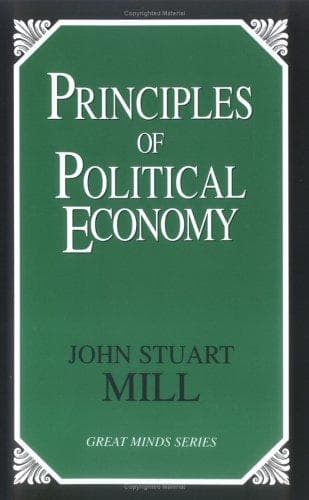
Principles of Political Economy: Abridged with Critical, Bibliographical, and Explanatory Notes, and a Sketch of the History of Political EconomyMill, John Stuart
PhilosophyPhilosophy
Principles of Political Economy: Abridged with Critical, Bibliographical, and Explanatory Notes, and a Sketch of the History of Political Economy
Mill, John Stuart
Economics
(1.) In a very backward state of society, like that of Europe in the
middle ages, and many parts of Asia at present, population is kept down by
actual starvation. The starvation does not take place in ordinary years,
but in seasons of scarcity, which in those states of society are much more
frequent and more extreme than Europe is now accustomed to. (2.) In a more
improved state, few, even among the poorest of the people, are limited to
actual necessaries, and to a bare sufficiency of those: and the increase
is kept within bounds, not by excess of deaths, but by limitation of
births.(124) The limitation is brought about in various ways. In some
countries, it is the result of prudent or conscientious self-restraint.
There is a condition to which the laboring-people are habituated; they
perceive that, by having too numerous families, they must sink below that
condition, or fail to transmit it to their children; and this they do not
choose to submit to.
There are other cases in which the prudence and forethought, which perhaps
might not be exercised by the people themselves, are exercised by the
state for their benefit; marriage not being permitted until the
contracting parties can show that they have the prospect of a comfortable
support. There are places, again, in which the restraining cause seems to
be not so much individual prudence, as some general and perhaps even
accidental habit of the country. In the rural districts of England, during
the last century, the growth of population was very effectually repressed
by the difficulty of obtaining a cottage to live in. It was the custom for
unmarried laborers to lodge and board with their employers; it was the
custom for married laborers to have a cottage: and the rule of the English
poor-laws, by which a parish was charged with the support of its
unemployed poor, rendered land-owners averse to promote marriage. About
the end of the century, the great demand for men in war and manufactures
made it be thought a patriotic thing to encourage population: and about
the same time the growing inclination of farmers to live like rich people,
favored as it was by a long period of high prices, made them desirous of
keeping inferiors at a greater distance, and, pecuniary motives arising
from abuses of the poor-laws being superadded, they gradually drove their
laborers into cottages, which the landowners now no longer refused
permission to build.
Public-domain text, read in full here on John Shaqi.
Reviews
Reviews
No reviews yet
Be the first to share your thoughts on this work.
Elsewhere in the archive
Join the Discussion
Join the discussion
Sign in to leave a comment or review.
Sign InorCreate an account