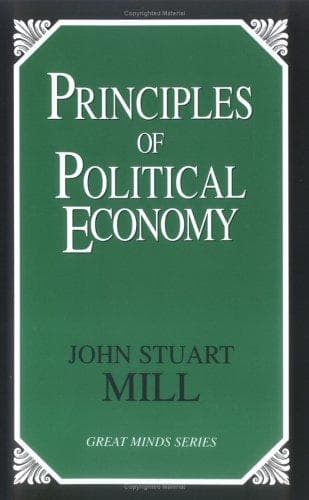
Principles of Political Economy: Abridged with Critical, Bibliographical, and Explanatory Notes, and a Sketch of the History of Political EconomyMill, John Stuart
PhilosophyPhilosophy
Principles of Political Economy: Abridged with Critical, Bibliographical, and Explanatory Notes, and a Sketch of the History of Political Economy
Mill, John Stuart
Economics
The requisites of production being labor, capital, and land, it has been
seen from the preceding chapter that the impediments to the increase of
production do not arise from the first of these elements. But production
has other requisites, and, of these, the one which we shall next consider
is Capital. There can not be more people in any country, or in the world,
than can be supported from the produce of past labor until that of present
labor comes in [although it is not to be supposed that capital consists
wholly of food]. We have next, therefore, to inquire into the conditions
of the increase of capital: the causes by which the rapidity of its
increase is determined, and the necessary limitations of that increase.
Since all capital is the product of saving, that is, of abstinence from
present consumption for the sake of a future good, the increase of capital
must depend upon two things—the amount of the fund from which saving can
be made, and the strength of the dispositions which prompt to it.
(1.) The fund from which saving can be made is the surplus of the produce
of labor, after supplying the necessaries of life to all concerned in the
production (including those employed in replacing the materials, and
keeping the fixed capital in repair). More than this surplus can not be
saved under any circumstances. As much as this, though it never is saved,
always might be. This surplus is the fund from which the enjoyments, as
distinguished from the necessaries of the producers, are provided; it is
the fund from which all are subsisted who are not themselves engaged in
production, and from which all additions are made to capital. The capital
of the employer forms the revenue of the laborers, and, if this exceeds
the necessaries of life, it gives them a surplus which they may either
expend in enjoyments or save.
It is evident that the whole unproductive consumption of the
laborer can be saved. When it is considered how enormous a sum is
spent by the working-classes in drink alone (and also in the great
reserves of the Trades-Unions collected for purposes of strikes),
it is indisputable that the laborers have the margin from which
savings can be made, and by which they themselves may become
capitalists. The great accumulations in the savings-banks by small
depositors in the United States also show somewhat how much is
actually saved. In 1882-1883 there were 2,876,438 persons who had
deposited in the savings-banks of the United States
$1,024,856,787, with an average to each depositor of $356.29. The
unproductive consumption, however, of all classes—not merely that
of the working-men—is the possible fund which may be saved. That
being the amount which _can_ be saved, how much _will_ be saved
depends on the strength of the desire to save.
Public-domain text, read in full here on John Shaqi.
Reviews
Reviews
No reviews yet
Be the first to share your thoughts on this work.
Elsewhere in the archive
Join the Discussion
Join the discussion
Sign in to leave a comment or review.
Sign InorCreate an account