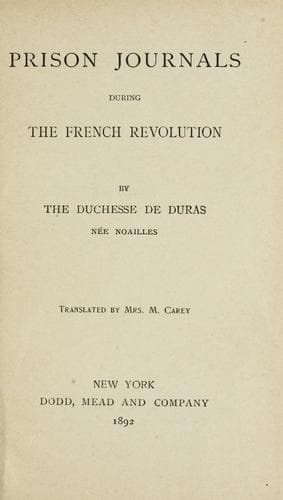
Prison Journals During the French RevolutionDuras, Louise Henriette Charlotte Philippine (de Noailles) de Durfort, duchesse de
History
Prison Journals During the French Revolution
Duras, Louise Henriette Charlotte Philippine (de Noailles) de Durfort, duchesse de
France -- History -- Revolution, 1789-1799 -- Personal narratives
My parents retired to their estate of Mouchy-le-Châtel, in the
Department of the Oise, in the month of September, 1792. I accompanied
them thither, and was their sole companion. They resolved, from
prudential motives, to receive visits from no one. This privation cost
my father nothing, for he was naturally shy, though the positions he
had occupied had forced him to live constantly in the great world. My
mother, who loved him dearly, accustomed herself to retirement with
submission to the will of Providence, with the naturally happy
disposition maintained through all the events of her life.
She loved system in all things, and she introduced it so successfully
into our daily life that it passed rapidly. Reading, work, play, and
walking filled up every moment. My parents took pleasure in furnishing
refreshment to the harvesters during their weary labour, in
sympathizing with their troubles, and in helping them by kindnesses. In
spite of the position in which the Revolution placed my father, and the
natural repugnance which he declared he felt for those who were engaged
in it, he gave volunteers the means of paying their way. My father had,
if I may so express myself, a passion for charity. His hands were
always ready to bestow, and whenever he received a sum of money he
would in a few hours declare, with satisfaction, that he had none of it
left.
He could keep nothing when he knew that others were suffering; hospital
visiting, aid rendered in private, all sorts of kind deeds and
comforting words,--in fact all good works were familiar to him; in
these alone he found happiness.
I have seen him refuse things which he might have considered necessary
for himself in order to add to the number of his charities. Yet my
father was born with a very unhappy disposition; the fortune, the
honours, and all the pleasures that his position secured him were
spoiled by the most miserable discontent. I frequently endeavoured,
firmly and respectfully, to show him that Heaven had bestowed every
gift upon him, and that nothing was wanting to his position. He
listened patiently to what I had to say; but I did not succeed in
convincing him. I worried myself and gained nothing. My mother, on the
contrary, often said to me that if she should return to society she
would not desire to change her manner of living in the least. She had a
charmingly happy disposition, and was never out of humour for a moment.
Several times during the Revolution it was proposed that I should
emigrate. One of my relatives sent for me at different periods, and
urged me to consent to do so. I always refused, having a great
repugnance to leaving my country, and desiring to watch over the old
age of my parents, who were already separated from some of their
children.
Public-domain text, read in full here on John Shaqi.
Reviews
Reviews
No reviews yet
Be the first to share your thoughts on this work.
Join the Discussion
Join the discussion
Sign in to leave a comment or review.
Sign InorCreate an account