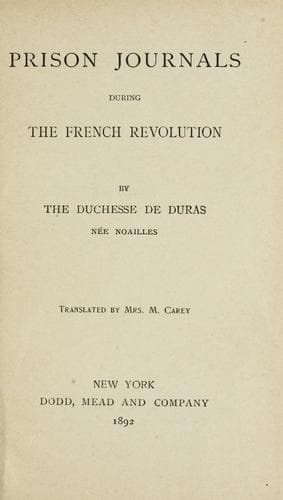
Prison Journals During the French RevolutionDuras, Louise Henriette Charlotte Philippine (de Noailles) de Durfort, duchesse de
History
Prison Journals During the French Revolution
Duras, Louise Henriette Charlotte Philippine (de Noailles) de Durfort, duchesse de
France -- History -- Revolution, 1789-1799 -- Personal narratives
Madame de Pons wrote several letters to Martin, asking only for a
delay; she offered all her property to the Republic; and the only
answer she received was, 'Your daughter must go!'
I busied myself in arranging my trunks and packing them for the
Luxembourg, so as to have with me only what was strictly necessary. On
the 3d of April, 1794, we were told to hold ourselves in readiness to
leave the next day or the day following, as the carriages were
expected. My travelling companions were in despair at leaving their
parents, but I delighted at going to see mine once more; every one said
pleasant things to me. I received many testimonials of interest and
regret from the prisoners. There were some from whom I was grieved to
part, and a secret presentiment (though generally I do not believe in
them) seemed to warn me that the reunion with my parents would never be
effected. The days of the 3d and 4th were passed in leave-taking. I did
not know that the train was to start early on the 5th, the anniversary
of the birth of my son. I was summoned at ten o'clock in the morning. I
found the wagons almost full; consequently I had a wretched seat next a
vile woman who boasted of being a friend of Robespierre, and told us
that she would receive on the way some marks of public interest. She
sat almost half on top of me; and to add to our suffering, the straw
which is usually put in the bottom of the carts for calves, was left
out. When we left, the courtyard was filled with our companions in
misery, who were mourning and sighing over our fate. They concealed
their tears, fearing to let them be seen.
Our procession stopped as it passed out of the gate, in order to have
the roll-call, lest some prisoner should have escaped; we were as
accustomed to it as the soldiers were. We were surrounded by the
National Guard, and remained an hour under the windows of the château,
in sight of mothers disconsolate at the removal of their daughters, and
who, with their hands raised to heaven, were giving them their
blessings. That sad sight is still distinctly before me. How many of
those who gave those blessings and of those who looked on were
sacrificed on the scaffold! I should like to be able to depict and
describe fully all that terrible and touching scene, but I cannot. As
for me I was terribly overcome, but I struggled to hide it.
The train was put in command of a printer's apprentice from Beauvais,
who went ahead of us. The first cart was filled with young girls, the
second with women, and three others with men. The vehicles were
surrounded by musketeers. We started at eleven o'clock in the morning,
in very bad weather. A terribly cold wind was blowing, and there were
no covers to our wagons.
At the entrances of towns and villages our escort was gathered
together, and we entered with dignity, drums beating.
Public-domain text, read in full here on John Shaqi.
Reviews
Reviews
No reviews yet
Be the first to share your thoughts on this work.
Join the Discussion
Join the discussion
Sign in to leave a comment or review.
Sign InorCreate an account