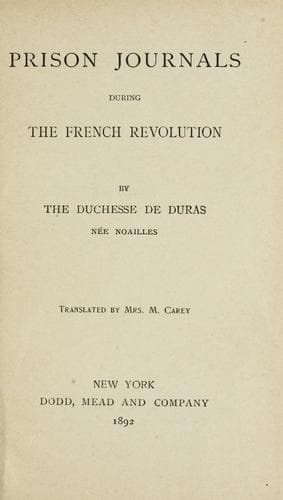
Prison Journals During the French RevolutionDuras, Louise Henriette Charlotte Philippine (de Noailles) de Durfort, duchesse de
History
Prison Journals During the French Revolution
Duras, Louise Henriette Charlotte Philippine (de Noailles) de Durfort, duchesse de
France -- History -- Revolution, 1789-1799 -- Personal narratives
My first night's rest was excellent. The intense fatigue I had suffered
the preceding days made me sleep. My young companion slept soundly and
late. When daylight appeared I found we had a fine view; I could see
the whole city of Paris. I reflected sadly upon the terrible condition
of my unhappy country, once so far-famed as a place where one could
spend peaceful, happy days. I thought of all the horrors which were
being committed there; the tears rose to my eyes, but I dried them
quickly so as not to discourage Mademoiselle de Pons when she first
awakened.
About eight o'clock in the morning the bolts were drawn and the keeper,
Haly, came in, followed by an enormous dog. This strange man greeted us
as though we were in one of the old-time châteaux where abundance,
peace, and pleasure reigned. He even seemed astonished that we were not
charmed with the pleasant lodgings he had given us. After he was gone,
and our companions' bolts were drawn, we eagerly gathered together, and
had no trouble in finding one another, as the corridor on which we were
lodged was only three feet wide. The first thing to be done was to
arrange about our meals. It was only after repeated requests that we
received permission to go down six steps to get water. The jailer who
had charge of us, as well as his comrades, assumed the title of warden,
thinking thus to render their office more honourable. There were three
classes of them, and almost all were drunkards, selfish, rapacious,
lying, while a few were absolutely ferocious. We specially noticed one
of them, who had taken part in the massacre of the 2d of September,
1792. This man, who at this time was our despot, was a sculptor; and I
was astonished that he should have accepted so miserable an employment.
After he had granted us permission to go for water, the need of having
something to eat made itself felt. The mess-table had not then been
established. I inquired how we could procure provisions at a moderate
price. An eating-house keeper sent us our dinner; but before he could
reach the floor on which we lodged, which was the highest in the house,
the food he carried was often taken from him as he passed along on the
other floors. Finding that I could not possibly live in this way, I
sent to learn whether my dinner could be sent me every day from my own
house. Lucas, my father's former clerk, was very anxious that this
should be done; but it was very difficult to find any one in the house
who was willing to bring it to me, as it was considered a dangerous
thing to do, and not very 'civic'. At last an old postilion named
Lerot, whose name I mention with gratitude, had the courage to
undertake it. A neighbour of the Hôtel Mouchy, said openly in the
street, when she saw him go by, that it was not worth while taking me
anything to eat because I was going to be guillotined. Two respectable
ladies clubbed together with me, and we divided our provisions,--they
furnishing some also; and we set about getting them cooked.
Public-domain text, read in full here on John Shaqi.
Reviews
Reviews
No reviews yet
Be the first to share your thoughts on this work.
Join the Discussion
Join the discussion
Sign in to leave a comment or review.
Sign InorCreate an account